Understanding Regular -ER Verbs in Present Tense: Conjugation Guide
60 likes | 213 Vues
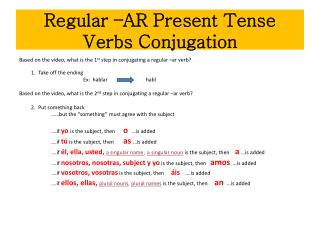
This guide provides an overview of regular -ER verbs in the present tense, highlighting their conjugation patterns. Regular -ER verbs end with -er, and their typical endings include -o, -es, -e, -emos, -éis, and -en. Examples such as "aprender" (to learn) and "leer" (to read) illustrate these conjugations. These rules are crucial for mastering verb usage in Spanish and form the foundation for building more complex language skills. Whether you're a beginner or improving, this overview is an essential resource for learning.


Understanding Regular -ER Verbs in Present Tense: Conjugation Guide
E N D
Presentation Transcript
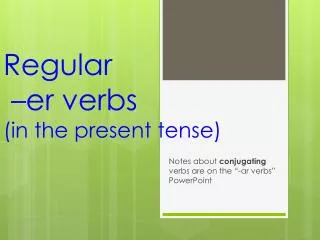
Regular –er verbs (in the present tense) Notes about conjugating verbs are on the “-arverbs” PowerPoint
So, what’s an –erverb? • An –erverb is one that ends in… -er
-erverb endings… -o -emos -éis -es -en -e