Understanding Stem-and-Leaf Displays for Data Visualization in Statistics
Stem-and-leaf displays are a statistical tool used to visualize actual data values, such as pulse rates. This method involves dividing data values into leading and trailing digits, allowing for an organized graph representation of data sets. In this example, we analyze the pulse rates of 39 Peruvian Indians, showcasing how stems represent initial digits while leaves indicate subsequent digits. With clear steps and real data, you can create your own stem-and-leaf displays for effective data analysis.

Understanding Stem-and-Leaf Displays for Data Visualization in Statistics
E N D
Presentation Transcript
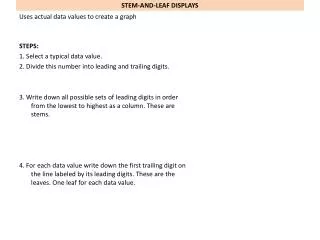
STEM-AND-LEAF DISPLAYS Uses actual data values to create a graph STEPS: 1. Select a typical data value. 2. Divide this number into leading and trailing digits. 3. Write down all possible sets of leading digits in order from the lowest to highest as a column. These are stems. 4. For each data value write down the first trailing digit on the line labeled by its leading digits. These are the leaves. One leaf for each data value.
STEM-AND-LEAF DISPLAYS Uses actual data values to create a graph (pulse rates of 39 Peruvian Indians) 52, 56, 60, 60, 60, 60, 60, 60, 64, 64, 64, 64, 64, 64, 64, 68, 68, 68, 68, 72, 72, 72, 72, 72, 72, 72, 72, 74, 76, 76, 76, 76, 80, 80, 84, 88, 88, 88, 92 STEPS: 1. Select a typical data value. 2. Divide this number into leading and trailing digits. 3. Write down all possible sets of leading digits in order from the lowest to highest as a column. These are stems. 4. For each data value write down the first trailing digit on the line labeled by its leading digits. These are the leaves. One leaf for each data value.
STEM-AND-LEAF DISPLAYS Uses actual data values to create a graph (pulse rates of 39 Peruvian Indians) 52, 56, 60, 60, 60, 60, 60, 60, 64, 64, 64, 64, 64, 64, 64, 68, 68, 68, 68, 72, 72, 72, 72, 72, 72, 72, 72, 74, 76, 76, 76, 76, 80, 80, 84, 88, 88, 88, 92 64 STEPS: 1. Select a typical data value. 2. Divide this number into leading and trailing digits. 3. Write down all possible sets of leading digits in order from the lowest to highest as a column. These are stems. 4. For each data value write down the first trailing digit on the line labeled by its leading digits. These are the leaves. One leaf for each data value.
STEM-AND-LEAF DISPLAYS Uses actual data values to create a graph (pulse rates of 39 Peruvian Indians) 52, 56, 60, 60, 60, 60, 60, 60, 64, 64, 64, 64, 64, 64, 64, 68, 68, 68, 68, 72, 72, 72, 72, 72, 72, 72, 72, 74, 76, 76, 76, 76, 80, 80, 84, 88, 88, 88, 92 64 STEPS: 1. Select a typical data value. 2. Divide this number into leading and trailing digits. 3. Write down all possible sets of leading digits in order from the lowest to highest as a column. These are stems. 4. For each data value write down the first trailing digit on the line labeled by its leading digits. These are the leaves. One leaf for each data value.
STEM-AND-LEAF DISPLAYS Uses actual data values to create a graph (pulse rates of 39 Peruvian Indians) 52, 56, 60, 60, 60, 60, 60, 60, 64, 64, 64, 64, 64, 64, 64, 68, 68, 68, 68, 72, 72, 72, 72, 72, 72, 72, 72, 74, 76, 76, 76, 76, 80, 80, 84, 88, 88, 88, 92 64 STEPS: 1. Select a typical data value. 2. Divide this number into leading and trailing digits. 3. Write down all possible sets of leading digits in order from the lowest to highest as a column. These are stems. 4. For each data value write down the first trailing digit on the line labeled by its leading digits. These are the leaves. One leaf for each data value. 5 6 7 8 9
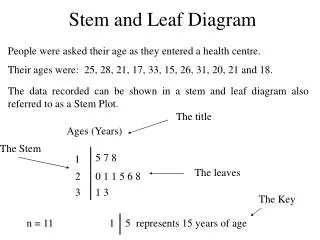
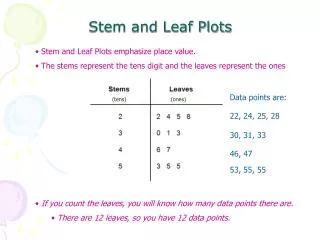
STEM-AND-LEAF DISPLAYS Uses actual data values to create a graph (pulse rates of 39 Peruvian Indians) 52, 56, 60, 60, 60, 60, 60, 60, 64, 64, 64, 64, 64, 64, 64, 68, 68, 68, 68, 72, 72, 72, 72, 72, 72, 72, 72, 74, 76, 76, 76, 76, 80, 80, 84, 88, 88, 88, 92 64 STEPS: 1. Select a typical data value. 2. Divide this number into leading and trailing digits. 3. Write down all possible sets of leading digits in order from the lowest to highest as a column. These are stems. 4. For each data value write down the first trailing digit on the line labeled by its leading digits. These are the leaves. One leaf for each data value. 5 6 7 8 9 5 26 6 00000044444448888 7 2222222246666 8 004888 9 2
VERSIONS OF STEM-AND-LEAF DISPLAYS Two-stem Display (2 lines per stem) Leaves * 0, 1, 2, 3, 4 . 5, 6, 7, 8, 9 Five-stem Display (5 lines per stem) Leaves * 0, 1 t 2, 3 f 4, 5 s 6, 7 . 8, 9
VERSIONS OF STEM-AND-LEAF DISPLAYS 5 26 6 00000044444448888 7 2222222246666 8 004888 9 2 Two-stem Display (2 lines per stem) Leaves * 0, 1, 2, 3, 4 . 5, 6, 7, 8, 9 5 2 5 6 6 0000004444444 6 8888 7 222222224 7 6666 8 004 8 888 9 2 INTERPRETATION Center (typical observations) Spread (variation, minimum and maximum observations) Shape (symmetry, number of peaks, skewness) Other (unusual observations in the data set
BACK-TOBACK STEM-AND-LEAF DISPLAYS Weights of 50 college students that were obtained from their medical reports. Female Male 8 188 0255688 00089 257 2 9 8 10 188 11 0255688 12 00089 13 257 14 2358 15 044578 16 122578 17 00667 18 3468 19 0155 20 5 21 5 9 10 11 12 13 14 358 15 044578 16 122578 17 00667 18 3468 19 0155 20 5 21 5