Download
1 / 19
190 likes | 306 Vues
Enhance your writing skills by exploring the four common patterns of essay organization: chronological order, logical division of ideas, cause and effect, and comparison and contrast. Each structure requires specific transition signals and vocabulary to ensure clarity. Additionally, for longer papers, you may need to combine these patterns effectively. Understand the nuances of punctuation, including the proper use of commas, semicolons, colons, and quotation marks, to strengthen your writing and prevent common errors like sentence fragments and run-on sentences.

E N D
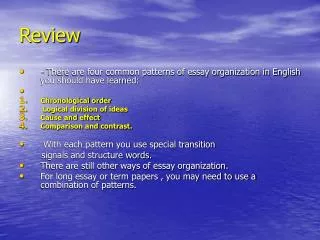
Review • - There are four common patterns of essay organization in English you should have learned: • Chronological order • Logical division of ideas • Cause and effect • Comparison and contrast. • With each pattern you use special transition signals and structure words. • There are still other ways of essay organization. • For long essay or term papers , you may need to use a combination of patterns.
Quiz • Write an essay on one of the following topics using a suitable • Generation Gap • University of Palestine • Learning English as a Foreign Language • Communication Revolution • How to write an essay • Internet in the 21st Century • You are required to show all steps on paper. -
Punctuation (p. 253- p. 261) • 1. Commas • 2. Semicolons • 3. Colons • 4. Quotation marks
Punctuation1. Commas • Commas functions as: • 1. Introducers • 2. Co-ordinators • 3. inserters • 4. linkers
Punctuation1. Commas • Commas functions as: • 1. Introducers: • e.g. Recently, the legislature banned smoking in public places. • _______, (main clause). • 2. Coordinator • Many people opposed the new law, but it finally passed. • Main clause___ (coordinating conjunction)__ Main clause
Punctuation1. Commas • Commas functions as: • 3. Inserter: Smallpox, once a widespread disease, is under control. Main ----------------------------------------clause • 4. Linkers: • e.g. (1): The word color is spelled colour in British English, for example. • Main Clause-----------------------------, ----------------. • e.g. (2): Cecile speaks English, French, Spanish, and Italian. • -----------, ---------, ---------,
Punctuation1. Commas See p. 254 & 256 for words used for different kinds of commas See practice I, p. 255
Punctuation semi - colons • The semi-colon is more like a period than a comma. • It is used between: • 1. Between two sentences that are closely connected in idea. e.g. Alice is going to Harvard; she isn’t going to M. I. T.
Punctuation semi - colons • It is used between: • 2. Before conjunctive adverbs and some traditional phrases. • Skiing is dangerous; nevertheless, hundreds of people ski.
Punctuation semi - colons • 3. Between items in a series if the items already contain commas. • See p. 257
Colons: • 1. Lists • 2. Long quotations • 3. Subtitles • 4. Time • 5. Formal salutations
Parallelism(p. 168) • Using similar grammatical structures to balance your writing. • If the first structure is a noun, make all the others nouns; if it is an infinitive verb phrase, make all of the others infinitive verb phrases; if it is a dependent clause, make all of the others dependent clauses. • with conjunctions (And, Or, But) • Correlative conjunctions
Sentence Problems • 1. Sentence Fragments • 2. Choppy Sentences • 3. Run-On sentences and Comma Splices • 4. Stringy Sentences
Sentence Problems: Sentence fragments (p. 171) • Sentence fragments are incomplete sentences or parts of sentences. • (A complete sentence must contain at least one main or independent clause) • See p. 171
Sentence Problems:Choppy Sentence • Choppy sentences are sentences that are too short. They are the result for using too many simple sentences. • Although simple sentences are quite effective sometimes, overuse of them is considered poor style in academic writing. • See, p. 173.
Sentence Problems:Run-On Sentences and Comma Splices (p, 175) • A run-on sentence is a sentence in which two or more independent clauses are written one after another with no punctuation. • A similar error happens when two independent clauses are incorrectly joined by a comma without a coordinating conjunction • N.B This kind of error is also called a comma splice. • Comma Splice means joining end to end.