SlideServe
Menu
Préférences
© SlideServe · v2026

Empowering Local Farmers through New Cassava Varieties: A Step towards Sustainable Livelihoods

claudia-rivera avatar
10 diapositives · 187 Views · Nov 20, 2014

Explore how innovative cassava varieties can enhance livelihoods impacted by hydropower development around the Yali reservoir in the Mekong River Basin. Discover the positive results of piloting the new variety and the collaborative efforts with local partners to support farmers.
Empowering Local Farmers through New Cassava Varieties: A Step towards Sustainable Livelihoods - slide 1
01 / 10Empowering Local Farmers through New Cassava Varieties: A Step towards Sustainable Livelihoods
1 / 17

Télécharger la présentation

Empowering Local Farmers through New Cassava Varieties: A Step towards Sustainable Livelihoods
Une image / un lien ci-dessous est fourni (tel quel) pour télécharger la présentation

Politique de téléchargement : le contenu du site vous est fourni TEL QUEL pour votre information et votre usage personnel ; il ne peut être vendu, concédé sous licence ni partagé sur d’autres sites sans l’accord de son auteur.Le contenu vous est fourni TEL QUEL, pour votre information et votre usage personnel uniquement. Téléchargez la présentation en cliquant sur ce lien. Lors du téléchargement, si vous ne parvenez pas à télécharger une présentation, l’éditeur a peut-être supprimé le fichier de son serveur.Pendant le téléchargement, si vous ne parvenez pas à obtenir une présentation, le fichier a peut-être été supprimé par l’éditeur.

F I N

Plus de contenu associé

Transcription de la présentation
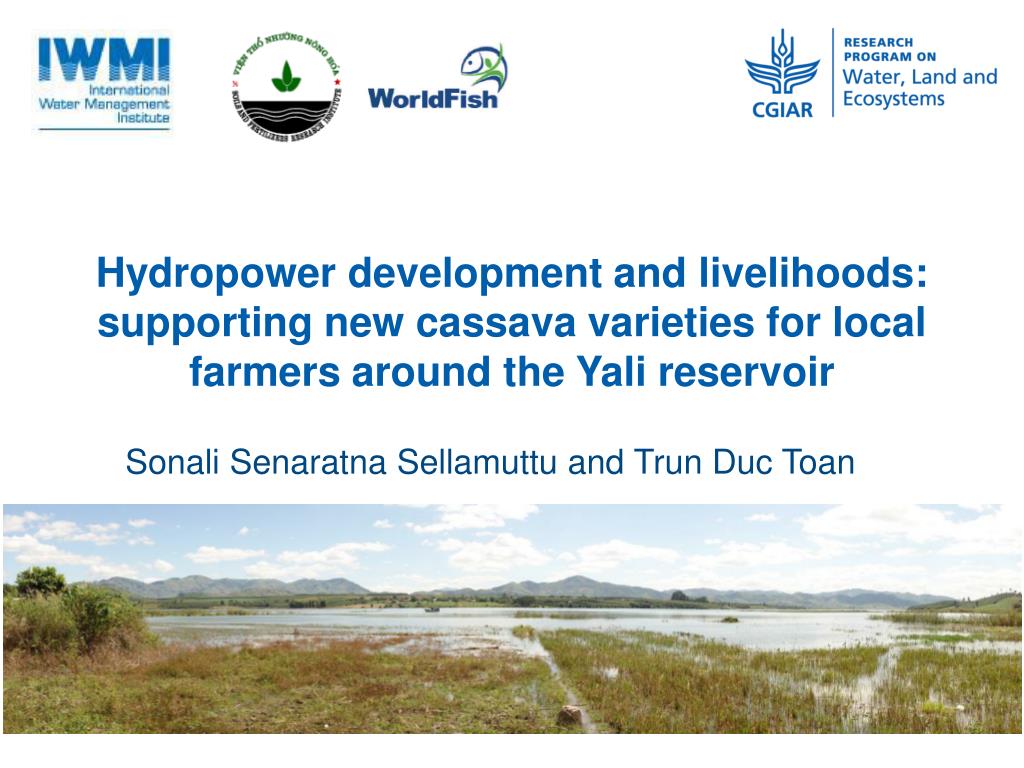
  1. Hydropower development and livelihoods: supporting new cassava varieties for local farmers around the Yali reservoir Sonali Senaratna Sellamuttu and TrunDucToan Place partner logos here

  2. Key development challenge The Mekong River Basin faces massive development investment with regard to hydropower. Little attention to how dams can be constructed and operated in ways that optimize benefits for all water users including impacted communities. Local people are unable to engage in their original livelihood activities Food insecurity another major challenge facing the Mekong region Research objective: identify and pilot test innovative livelihood options that use the new environmental conditions created as a result of the hydropower development

  3. Research conducted to address key challenges Broad scale and household level livelihood surveys: 250 HHs (male/female respondents) in 4 communes; includedKinh and ethnic minorities - Jarai. Sa Binh YaXier Yali Ya Tang

  4. Draw down agriculture in Yali Falls water- energy-agriculture nexus • Drawdown area of Yali reservoir is used by farmers to grow cassava but: • risk of flooding is high at the end of the crop season • duration on land exposure is too short to achieve max yield with the commonly used variety (KM 94)

  5. Livelihood pilot: new cassava variety in the Yali drawdown • Livelihood pilots - introduction of a new short term variety (KM98-7) • 2012: 3 farmers – 1.5 ha – 1 commune (Sa Binh) • 2013: 36 farmers – 20 ha – 2 communes (Sa Binh and Yali) • Pilots produced positive results • Increase yield and starch content • 32 tons/ha vs 21 tons/ha • 26% starch vs 21% starch • Increased net benefit over $350 USD/ha to $850 USD/ha

  6. Key outputs • Training courses and field visits were organized in 2012-2013 for over 500 farmer HHs (both men and women) in the 4 communes (both Kinh and Jarai ethnic groups) • Training material produced • Papers, presentations and posters

  7. Our partners and their roles Local government: Department of Agriculture and Rural Development (DARD) played a facilitation role to strengthen the interactions between the research institutes (IWMI, SFRI) and local farmers (ensured that ethnic minority groups participated in the livelihood pilot). Dam operator: Cooperation of the dam operator by sharing information on the water regime that helped analyze the duration of land exposure - key for making decisions on alternative cropping systems in a semi-flooded land area

  8. Key outcomes • Better communication between local communities and dam operator (signed agreement to provide reservoir water level calendar) • Increased capacity of local authorities and farmers (both women and men and also different ethnic groups) • A change in attitude of hydropower companies toward the drawdown area of HP reservoirs (up-scaling to neighbouring reservoir)

  9. Next Steps • Scaling-up livelihood pilot to neighboringPlei-Krong reservoir. Lessons on process of going to scale and impact. • A more in-depth understanding of how women/men; Kinh/Jarai benefit differently from the successful pilots (increase in income) and factors underlying these differences

  10. Thank You