Understanding Fish: Characteristics, Importance, and Conservation Challenges
Fish, cold-blooded aquatic vertebrates with gills and fins, exhibit diverse shapes and sizes, from the tiny pygmy goby to the massive whale shark. Historically, fish have been vital to human diets, especially in primitive societies and industrialized nations alike. Overfishing, pollution, and population growth threaten fish populations globally. Effective conservation is critical, yet enforcing regulations remains a challenge. This overview emphasizes the significance of fish in our ecosystems and food systems, highlighting the urgent need for sustainable practices to protect these valuable resources.


Understanding Fish: Characteristics, Importance, and Conservation Challenges
E N D
Presentation Transcript
FISH BY MATTEA AQUILINA Grade 5 Alpha Ms. Christine
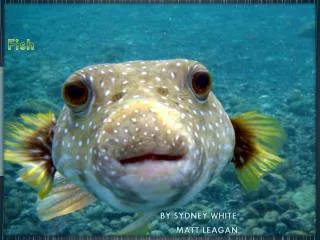
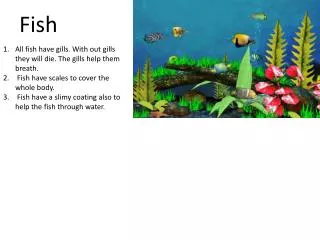
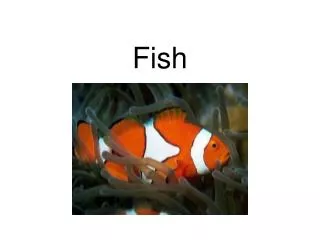
Fish are cold-blooded aquatic animals with backbones, gills, and fins. Most fishes are torpedo-shaped (fusiform) for efficient travel through water, but much variation occurs, from flattened and rounded, as in flounders, to vertical and angular, as in sea horses. Fishes range in size from the pygmy goby, Pandakapygmaea, of the Philippines, which reaches only 12 mm (0.5 in) long and about 1.5 g (0.05 oz) in weight and is sexually mature at 6 mm (0.25 in), to the whale shark, Rhincodontypus, which grows to 18 m (60 ft) long and over 20 tons in weight.
Fish were among the first animals systematically hunted by primitive humans. Even today, relatively primitive societies in the South Pacific and South America depend largely on fish for food; while in many industrialized nations, fish still constitute a major part of the diet. It is said that the search for codfish led French fishermen to the discovery of Canada and that villages sprang up on the coasts of Norway, Scotland, Japan, and other countries wherever shoals of herrings regularly came close to shore. Today fishes are harvested for unprocessed human food, fish meal, animal feed, and oil. They also are pursued avidly by sport anglers, who contribute to the economy of fishing areas and to specific industries. Currently, however, the increasing human population, overfishing to supply this population, and pollution of the world's waters are all cutting heavily into the world supply of fish, and threatening the existence of a number of species. At the same time, regulations to curtail the taking of certain species or sizes are virtually unenforceable on an international level.
The END BYE BYE