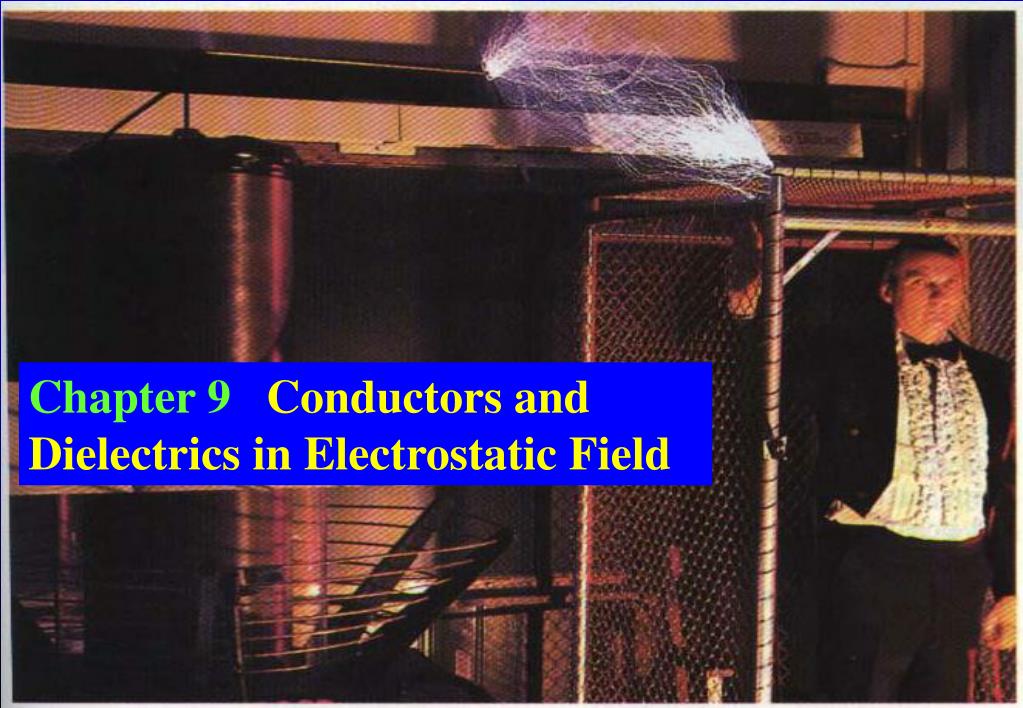
Chapter 9 Conductors and Dielectrics in Electrostatic Field. §9-1 Conductors 导体 Elecrostatic Induction 静电感应 . §9-2 Capacitance 电容器. §9-3 Dielectrics 电介质. §9-4 Gauss’ Law in Dielectric 有电介质时的高斯定律 Electric Displacement 电位移 . §9-5 Energy in Electric Field 电 场的能量.
01 / 51Chapter 9 Conductors and Dielectrics in Electrostatic Field
1 / 17
Télécharger la présentation
Chapter 9 Conductors and Dielectrics in Electrostatic Field
Une image / un lien ci-dessous est fourni (tel quel) pour télécharger la présentation
Politique de téléchargement : le contenu du site vous est fourni TEL QUEL pour votre information et votre usage personnel ; il ne peut être vendu, concédé sous licence ni partagé sur d’autres sites sans l’accord de son auteur.Le contenu vous est fourni TEL QUEL, pour votre information et votre usage personnel uniquement.Téléchargez la présentation en cliquant sur ce lien.Lors du téléchargement, si vous ne parvenez pas à télécharger une présentation, l’éditeur a peut-être supprimé le fichier de son serveur.Pendant le téléchargement, si vous ne parvenez pas à obtenir une présentation, le fichier a peut-être été supprimé par l’éditeur.
§9-1 Conductors 导体 Elecrostatic Induction 静电感应 §9-2 Capacitance 电容器 §9-3 Dielectrics 电介质 §9-4 Gauss’ Law in Dielectric 有电介质时的高斯定律 Electric Displacement 电位移 §9-5 Energy in Electric Field 电场的能量
§ 9-1 Conductors and Electrostatic Induction can move in the conductor randomly e e e e e e e e Conductor: There are many free electrons in it.
2. Electrostatic equilibrium (1). Electrostatic equilibrium state:There is no any charge moving along a definite direction macroscopically inside the conductor or on the surface of the conductor. The distribution of charges does not change with time. (2). Electrostatic equilibrium conditions:
E=0 The behavior of E-field The E-field equals zero everywhere inside the conductor. The E-field at the surface of the conductor is perpendicular to the surface. The behavior of E-potential The conductor is an equipotential body. The conductor surface is an equipotential surface.
Electrostatic field influences conductor: --electrostatic induction --make the charges in conductor redistribution. Conductor influences electrostatic field : -- make the electrostatic field redistribution. Example
P--any point inside conductor, S--infinite small, No excess charge inside conductor. 3. The charge distribution on conductor at the electrostatic equilibrium state. (1). Entire conductor: No excess charges inside the conductor. They are found only on the conductor surface. Prove: Use S--any Gaussian surface inside conductor
(2). A conductor with a cavity:Assume charged Q No charge in the cavity: No charge inside and internal surface of the conductor. All the excess charges distribute on the outside surface of conductor. Prove: Draw a Gaussian surface S surrounding the cavity tightly.
Inside the conductor Question?Are thereany equal magnitude and opposite sign charges on the internal surface of the conductor? i.e., --No net charge inside S Not at all.
There are charges q in the cavity: On the inner surface of the conductor: --induction charges -q On the external surface of the conductor : The original charges Q of the conductor + induction charges +q
Example: Two conducting spheres of different radii connected by a long conducting wire. 3.The relation about the charge distribution on the conductor surface and the its radius of curvature. They are equipotential.
- - - - - - - - - - In a qualitative way, for a conductor of arbitrary shape, the charge density distribution on its surface is inverse proportional with its radius of curvature.
. p 4. The relation about the E-field justoutside the conductor surface and the charge density on the conductor surface. is set up by all charges in the space (on and outside the conductor).
+ + + + + + - + + + Electrostatic generator candle 5. Application of electrostatic induction. (1).Tip discharge Lighting rod(避雷针) Electrostatic generator and electric wind (2).Electrostatic shielding
The examples about electrostatic induction [Example 1]A neutral conductor sphere with radius R is put on the side of a point charge +q . Assume the distance between the spherical center and the point charge is d. Calculate: The E-field and potential at point 0 set up by the induced charges on the sphere.If the sphere is connected with the ground, how much is the net charge on the sphere?
Solution Assume the induction charges are±q The total field at 0 = the field set up by q+ the field set up by ±q =0!!
QB QA σ1 σ2 σ3 σ4 [Example 2] Two large parallel plates with the area S carry charge Qa and QB respectively. Find:The charge and field distribution. solution Assume the charge surface density areσ1,σ2,σ3 andσ4 on the four surfaces .
Ⅲ Ⅰ Ⅱ E1 E1 E2 E2 E3 E3 E4 E4 The field distribution: E=0inside the plates outside the plates: direction: point to left point to right point to right
Ⅲ Ⅰ Ⅱ Two plates carry equal magnitude and opposite sign charge discussion the charges distribute on the inner surface only. EⅠ= EⅢ= 0
Ⅲ Ⅰ Ⅱ Two plates carry equal magnitude and same sign charge Charges distribute on the exterior surface only.
[Example 3] conductor sphere with radius r1 carries +q and conductor spherical shell with inner and exterior radii r2 and r3 carries +Q. Calculate theE distribution, the potential of sphere and shell U1 and U2, potential difference△U Connect sphere and shell with a wire, find E, U1 and U2 ,△U =?. If the shell is connected with ground, findE, U1 , U2, △U =? If the sphere is connected with ground, find the charge distribution. U2=?