Understanding Climate Factors: The L.O.W.E.R.N. Method
Explore the key factors influencing climate through the L.O.W.E.R.N. acronym: Latitude, Ocean Currents, Winds and Air Masses, Elevation, Relief, and Near Water. Each factor plays a crucial role in determining temperatures and climate patterns across regions. For instance, latitude affects the concentration of the sun's energy, while ocean currents moderate coastal climates. Understanding these elements can help predict weather conditions and climate changes, including the impact of global warming on ocean currents like the Global Conveyor Belt.

Understanding Climate Factors: The L.O.W.E.R.N. Method
E N D
Presentation Transcript
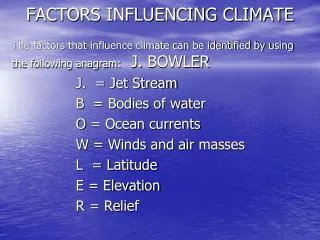
a good way to remember the factors: L - latitude O – ocean currents W – winds and air masses E - elevation R - relief N – near water
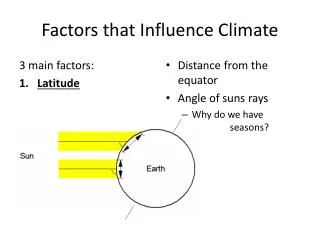
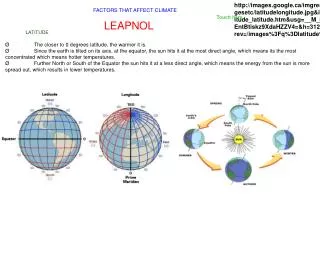
Latitude • sun’s energy is “more concentrated” near the equator • large amount of energy over a small area • sun’s energy is “less concentrated” the farther north or south of the equator you go • large amount of energy over a large area
therefore, distance from the equator is a key factor in determining whether a region has a hot or cold climate • places farther away from the equator experience colder temperatures than those near the equator
the temperature of an ocean current affects the temperature of the air that passes over it • here’s how it works; on the west coast the North Pacific Current heats the cool air that passes over it giving the coastal regions of B.C. a milder climate
the sun heats the ground of the Earth, which heats the air above it and causes this air to rise • this produces a “low pressure” area • air cools as it rises and thus sinks back down to the surface • this produces a “high pressure” area
air moves along the surface of the Earth from high-pressure areas to low-pressure areas • this moving air causes wind • these winds move air masses that affect the climate of an area
Elevation • temperature decreases as elevation increases • as air rises, it cools
Relief • mountains form a natural barrier that cause air masses to rise • as air is forced to rise itcools • as air descends on the other side of the mountain it’s temperature increases
Near Water • large bodies of water heat up/cool down slower than land • in the summer water is cooler than land and in the winter water is warmer than land • the water heats/cools the air above it • winds blowing then move this warm/cool air over the land moderating its temperature
Ocean water moves because of differences in density • Water that is denser sinks below water that is less dense • Changes in temperature and salinity can change the density of seawater • Cold water is denser than warm water • Saltier water is denser than less salty water
Human • Global Warming – rising of the earth’s temp • can “break” or “push south” the Global Conveyor Belt by melting glaciers in Northern Canada and the Arctic