Download
1 / 16
160 likes | 274 Vues
This resource provides an overview of anatomical position, critical for studying human anatomy. The anatomical position is defined by the body being erect, with feet slightly apart and arms at the sides, palms facing forward. The guide covers essential concepts like body orientation, planes, sections, and various body cavities. Detailed figures illustrate anterior and posterior landmarks, enhancing comprehension of the human body's organization. Key tables outline body orientation and direction, making this an essential tool for students and professionals in biological sciences.

E N D
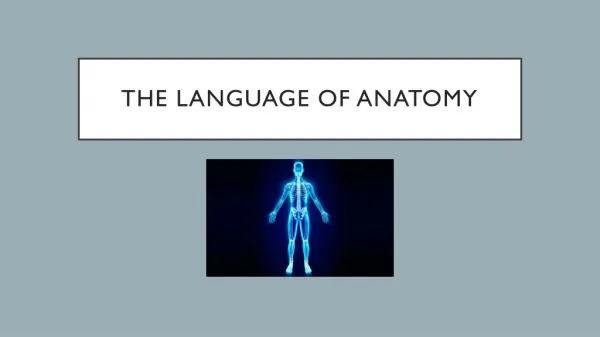
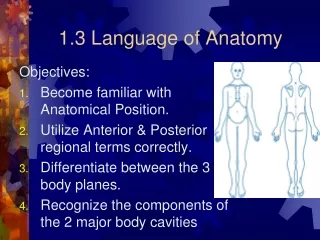
Anatomical Position • Positions of areas are determined relative to the standard anatomical position. • Body is erect, feet slightly apart, head, toes and hand pointing forward. • Surface Anatomy. • Body Orientation and direction • Body Planes and sections • Body Cavities.
Surface Anatomy Anterior Body Landmarks Anatomical position Figure 1.7a
Posterior Body Landmarks Figure 1.7b
Body Orientation and Direction Table 1.1.1
Body Orientation and Direction Table 1.1.2
Body planes and sections Figure 1.8
Body Cavities Figure 1.9
Abdominopelvic surface and cavity Figure 1.11
Other Body Cavities Figure 1.13
Organ Systems Figure 1.3a–c