Regulated Pushdown Automata
This presentation discusses regulated pushdown automata (PDA), a computational model that enhances traditional pushdown automata with control languages. Presented by Alexander Meduna at Kyoto Sangyo University in 2006, the talk explores their defining principles, their correlation with regulated grammars, and their classifications within language families such as context-free and recursively enumerable languages. Key results highlight the implications of regulated PDAs for computational linguistics and automata theory, supported by foundational references and examples illustrating their operation.

Regulated Pushdown Automata
E N D
Presentation Transcript
Regulated Pushdown Automata 1/22 Alexander Meduna Faculty of Information Technology Brno University of Technology Brno, Czech Republic, Europe Presented at Kyoto Sangyo University, Kyoto, Japan March 9, 2006
Fundamental References 2/22 • Meduna Alexander, Kolář Dušan: • Regulated Pushdown Automata,Acta Cybernetica, • Vol. 2000, No. 4, p. 653-664 • Meduna Alexander, Kolář Dušan: • One-Turn Regulated Pushdown Automata and Their Reduction, Fundamenta Informatica, • Vol. 2002, No. 16, p. 399-405
Inspiration: Regulated Grammars 3/22 • Grammar G: 1.S AC 2.A aAb 3.A ab 4.C Cc 5.C c • = {1}{24}*{35}
Regulated Grammars 1/2 4/22 • Grammar G: • Without , G • generates aabbccc: 1.S AC 2.A aAb 3.A ab 4.C Cc 5.C c S AC[1] aAbC[2] aAbCc[4] aabbCc[3] aabbCcc[4] aabbccc[5] = {1}{24}*{35} L(G) = {anbncm: n, m 1}
Regulated Grammars 2/2 5/22 • with,Gdoesnotgenerateaabbccc,because • 124345 = {1}{24}*{35} • with, G generates aabbcc: S AC[1] aAbC[2] aAbCc[4] aabbCc[3] aabbcc[5] and 12435 L(G,) = {anbncn: n 1}
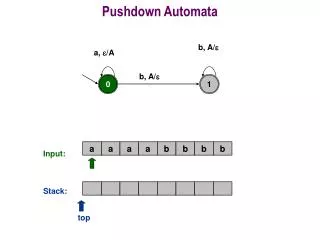
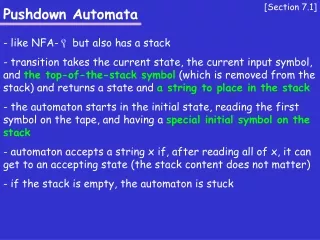
PDA: Notation 6/22 • A PDA is based on a finite set of rules of the form: pushdown symbol states Aqaxp input symbol or pushdown string
New Concept: Regulated PDAs 7/22 • PDA M: 1.Ssa Sas 2.asa aas 3.asb q 4.aqb q 5.Sqc Sq 6.Sqc f • = {12m34n5n6: m, n 0}
Regulated PDAs 1/2 8/22 • PDA M: • Without , M • accepts aabbccc: 1.Ssa Sas 2.asa aas 3.asb q 4.aqb q 5.Sqc Sq 6.Sqc f Ssaabbccc Sasabbccc[1] Saasbbccc [2] Saqbccc [3] Sqccc[4] Sqcc[5] Sqc[5] f[6] = {12m34n5n6: m, n 0} L(M) = {anbncm: n, m 1}
Regulated PDAs 2/2 9/22 • with, Mdoes notacceptaabbcccbecause • 1234556 = {12m34n5n6: m, n 0} • with, Maccepts aabbcc: Ssaabbcc Sasabbcc[1] Saasbbcc [2] Saqbcc [3] Sqcc [4] Sqc[5] f[6] and123456 L(M,) = {anbncn: n 1}
Gist: Regulated PDAs 10/22 • Consider a pushdown automaton, M, and • control language, . • M accepts a string, x, if and only if • contains a control string according to • which M makes a sequence of moves soit • reaches a final configuration after readingx.
Definition: Regulated PDA 1/4 11/22 A pushdown automaton is a 7-tuple M = (Q, , , R, s, S, F), where • Q is a finite set of states, • is an input alphabet, • is a pushdown alphabet, • Ris a finiteset of rules of the form: • Apa wq,where • A ,p,q Q, a {},w * • s Q is the start state • S is the start symbol • F Q is a set of final states
Definition: Regulated PDA 2/4 12/22 • Let be an alphabet of rule labels. Let every • ruleApawqbelabeledwithauniqueas • . Apa wq. • AconfigurationofM,,isanystringfrom*Q* • For every x *, y *, and . Apa wq R, • M makes a move from configuration xApay to • configuration xwqy according to , written as • xApay xwqy []
Definition: Regulated PDA 3/4 13/22 • Let be any configuration of M. M makes zero • moves from to according to , writtenas • 0 [] • Let there exist a sequence of configurations • 0, 1, ..., nforsomen 1suchthati-1i[i], • wherei,fori= 1,...,n,thenMmakes n moves • from 0 to n according to [1 …n], written as • 0 n n [1... n]
Definition: Regulated PDA 3/4 14/22 • If forsomen 0,0 n n [1... n], we write • 0 * n [1... n] • Letbeacontrollanguageover,thatis,*. • With , M accepts its language, L(M, ), as • L(M, ) = {w: w *,Ssw*f [], }
Language Families 15/22 • LIN- the family of linear languages • CF- the family of context-free languages • RE- the family of recursively enumerable • languages • RPD(REG)- the family of languages accepted • by PDAs regulated by regular • languages • RPD(LIN)- the family of languages accepted • by PDAs regulated by linear languages
Theorem 1 and its Proof 1/2 16/22 RPD(REG) = CF Proof: I.CF RPD(REG) is clear. II.RPD(REG) CF: • Let L = L(M, ), PDA Regular language • Let = L(G), G - regular grammar based • on rules: A aB,A a
Theorem 1 and its Proof 2/2 17/22 Transform M regulated by to a PDAN as follows: 1) for every a.Cqbxp from M and every AaB from G, add C<qA>b x<pB> to N 2) for every a.Cqbxp from M and every Aa from G, add C<qA>b x<pf> to N New symbol 3)The set of final states in N: {<pf>: p is a final state in M}
Theorem 2 18/22 RPD(LIN) = RE Proof: • See [Meduna Alexander, Kolář Dušan: • Regulated Pushdown Automata,Acta Cybernetica,Vol. 2000, No. 4, p. 653-664]
Simplification of RPDAs 1/2 19/22 • I. consider two consecutive moves made by a pushdown automaton, M. • If during the first moveM does not shorten its pushdown and during the second move it does, then M makes a turn during the second move. • A pushdown automatonis one-turn if it makes no more than one turn during any computation starting from an initial configuration.
One-Turn PDA: Illustration 20/22 Length of pushdown One-turn Moves
Simplification of RPDAs 2/2 21/22 II. During a move, an atomic regulated PDA changes a state and, in addition, performs exactly one of the following actions: 1. pushes a symbol onto the pushdown 2. pops a symbol from the pushdown 3. reads an input symbol
Theorem 3 22/22 • Every L RE is accepted by an atomic one-turn PDA regulated by , where LIN. Proof: • See [Meduna Alexander, Kolář Dušan: • One-Turn Regulated Pushdown Automata and Their Reduction, Fundamenta Informatica,Vol. 2002, No. 16, p. 399-405] End