CSTNET Update
This document outlines significant updates in hybrid network technologies and the application of CNGI, focusing on key equipment updates and expansions in various cities including Beijing, Shanghai, and others. It highlights the infrastructure supporting over 100 disciplinary research networks and more than 60 institutes, detailing their focus areas such as high-energy physics, astronomy, and bioscience. The document also discusses the ITER project aimed at demonstrating fusion power viability, as well as ongoing collaborations in cosmic ray research leveraging advanced data-sharing networks.

CSTNET Update
E N D
Presentation Transcript
CSTNET Update Jiangning Chen cjn@cstnet.cn 08-30-2007
Contents • Hybrid network • CNGI • application
ONS 15454 Mar 2006 Equipment update OME 6500 Aug 2007(HK and BJ) GSR 12008 Before 31 July 2005 GSR 12410 31 July 2005 Equipment Update
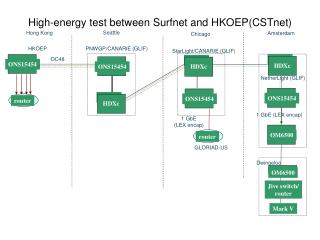
Beijing HKOEP— hybrid network • 2.5G-4*622M • HK-Chicago(GLORIAD-US,GLORIAD-RU) • HK-Amsterdam (testing for HEP application) • HK-Amsterdam-JIVE (testing for VLBI connection) • HK-Seattle (Gloriad backup, also to be a participant of Pacificwave) • VCAT-Support more application on flexible need virtual concatenation Shanghai
Missions of CSTNET in CNGI • The access of IPv6 network for 100 disciplinary research networks and institutes • Disciplinary research networks: about 30 networks cover many specific areas, most of them in Beijing • Institutes: more than 60 institutes around china, most of them are institutes in CAS • Beijing, Shanghai,Guangzhou • Shenyang, Chuangchun, Chendu, Lanzhou • Xian, Nanjing, Xinjiang, Wuhan, Kunming, Hefei • Connection Bandwidth • At Least 1G (1G/10G) • Circuit Resource: Optical Fiber are provided in Beijing and Local Connection in Sub-center for further expansibility
Resources on disciplinary research networks • China environmental Science Network • Chinese Area Integration science and technology Data Sharing Network • National Science and technology Library Network • Research of Petroleum Processing Network • National Center for Nanoscience and Technology Network • National Metrology Science Network • China Academy of Railway Sciences Network • China Water Resources and hydropower Research Network • Genomics Science Network • China Academy of Telecommunication Technology Network • Network of Chinese Center for Disease Control and Prevention • Chinese Academy of Social Sciences Network • Architectural Design Science Network • China Earthquake Data Center • China meteorological Data Sharing Network • China topography Science Data Sharing Network • China Forestry Data Sharing Network • Data-Sharing Network of Earth System Science • Network of Science on State Land and Resource • Sustainable Development Information Center • Geognosy and Mineral Resource Data Sharing Network • Chinese Medical and Health Network • China Communications Science Network • Basic Science Date Center • Advanced Manufacturing and Automation Network • China Hydrology Science Network • Chinese Academy of Agriculture Sciences Network
Applications • Focus • Sharing Scientific Data • Sharing Scientific Equipment • Cooperation on research projects • Improve research methods with digitalization, Informatization • Most interesting areas • High Energy Physics • Astronomy • Bioscience • Geo Science • Environment • Atmosphere
ITER Project • What is ITER? ITER is a joint international research and development project that aims to demonstrate the scientific and technical feasibility of fusion power. The partners in the project - the ITER Parties - are the European Union (represented by EURATOM), Japan, the People´s Republic of China, India, the Republic of Korea, the Russian Federation and the USA. ITER will be constructed in Europe, at Cadarache in the South of France. • Goal of ITER demonstrate the scientific and technological feasibility of fusion power for peaceful purposes".
International Cosmic RayPre-Process Center • YBJ International Cosmic Ray Observatory is located at 90°26'E and 30°13'N in Yangbajing (YBJ) valley of Tibetan highland. The ARGO -YBJ Project is a Sino-Italian Cooperation started its detector installation in 2000. It aims at the research of the origin of high energy cosmic rays. It explores the approximately 100 GeV uncultivated land and measuring the antiproton/proton ratio by cosmic ray moon shadow. • ARGO RPC carpet project • 10000+ detectors • raw data: 200TB/year • reconstruction data: 20TB/year • computing power: 400+ CPUs Cosmic ray air-shower array detector China-Japan CollaborationYangbajing , Tibet 4300m a.s.l.