Exploring Cubism: Deconstructing Reality Through Geometric Artistry
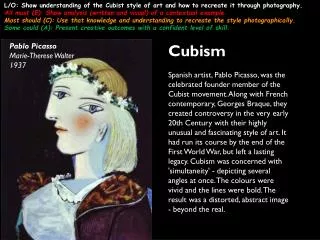
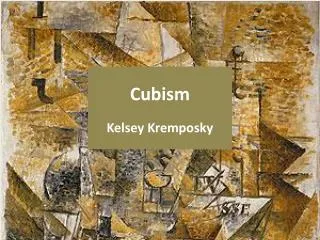
Cubism, pioneered by artists like Pablo Picasso and Georges Braque, sought to deconstruct reality using geometric designs that visually stimulate viewers. Influenced by African, Micronesian, and Native American art, Cubism is divided into two main styles: Analytical Cubism (1910-1912) focusing on the breakdown of form with right angles and simple color schemes, and Synthetic Cubism (after 1912) emphasizing the synthesis of forms, vibrant colors, and mixed techniques. This transformative art movement questioned the nature of reality and illusion, reshaping perceptions of art through innovative techniques.


Exploring Cubism: Deconstructing Reality Through Geometric Artistry
E N D
Presentation Transcript
Themes: Sought to deconstruct reality by using geometric designs as visual stimuli to re-create reality in the viewer’s mind Influences: • African art (esp. tribal masks) • Micronesian art • Native American art
Styles Analytical Cubism • Period from 1910-1912 • breaking down or analysis of form • Right angle and straight lines • Simplified color schemes • Complex, multiple views of object • Forms generally compact and dense in the center growing larger towards the edges Synthetic Cubism • After 1912 • Emphasis on combination or synthesis of forms in picture • Color extremely important in shapes • Smooth and rough surfaces contrast with each other • Frequently non-painted objects such as newspapers or tobacco wrappers are pasted on canvas and combined with painted areas • Emphasis on differences in textures • What is reality and what is illusion
Techniques • Emphasized the flat, 2D surface of the picture plane • rejected traditional techniques (perspective, foreshortening, modeling, and chiaroscuro • showed fragmented objects • cubist paintings showed letters, musical instruments, bottles, pitchers, glasses, newspapers, still lifes, and the human face/figure • analytical cubism (1910-1912)- paintings during this time portrayed breaking down/analysis of form, right angles and straight lines- colors were simple (tans, browns, blacks, grays, creams) to distract people from the primary interest the structure of form which are compact and dense • synthetic cubism (after 1912)- emphasizes the blend of forms. colors are very important because they are larger and more decorative- had both smooth and rough surfaces including non-painted objects were put on the canvas (newspapers and tobacco wrappers) - stressed differences in texture and questioned what reality really was Bread and Fruit Dish on a Table – Picasso
Pablo Picasso Pablo Picasso • One of the founders of Cubism Portrait of AmbroiseVollard Les Demoiselles d' Avignon
George Braque George Braque • Another founder of Cubism House at L'Estaque Violin and Pitcher
Henri Matisse Henri Matisse • Influenced by Henri Matisse
Connections • Like Freud and Nietzsche, Cubist artists rejected rationalism