
LCLS Timing
E N D
Presentation Transcript
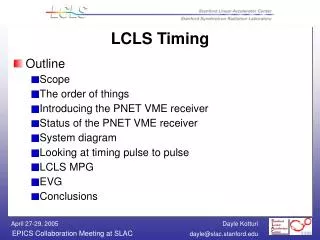
LCLS Timing • Outline • Scope • SLC Master Pattern Generator • Introducing the PNET VME receiver • Status of the PNET VME receiver • System diagram • Timing pulse to pulse • LCLS MPG • Event Generator and Event Receiver • Costs • Conclusions
Scope • LCLS timing system is used to transmit a fiducial 360 Hz signal to all triggered devices in LCLS • System requirements (speed and content) are known: receive 128 bit PNET data at 360 Hz; append add’l info; operate at 120 Hz • The component parts are known: PNET VME receiver, EVG-200 and EVR-200 • The interfaces are being defined
SLC Master Pattern Generator • The one and only SLC Master Pattern Generator (MPG) • Takes as input: 360 Hz fiducial from SLC PDU is the signal to create a new PNET buffer • Performs tasks: • creates PNET buffers • responds to faults • Outputs PNET buffers to all micros and PNET VME receiveron the next 1/360 s fiducial
Status of the VME PNET receiver • Hardware prototype is finished (1 instance) • Board is 3 slots wide to accommodate on board cable modem interface to PNET • Engineering Design Specification doc written • Driver and device support (bi, mbbiDirect to access each variable in PNETbuffer) written. Compiled only for Synergy PPC running RTEMS 4.6.2
LCLS MPG • Takes the PNETbuffer with appended epicsTimeStamp and checksum fault indicators • Adds on LCLS application commands • Adds on any newly detected faults • Writes modified buffer into EVG’s memory, setting flag when done
Event Generator (EVG) • On board FPGA packages/chunks 24 byte LCLS MPG data and sends 2 byte packets to EVR at 125 MHz • Data arrives in EVR in 0.6 microseconds + fiber travel time (which depends on distance) • Driver and device support exists (for sending smaller-sized packets). Conversion to RTEMS (from VxWorks) in progress
Event Receiver (EVR) • Resides in SLC-aware IOC • Receives EventBuffer (EB) from EVG • Contents of EB determine actions taken by SLC-aware IOC during current beam pulse • Driver and device support exists (for receiving smaller-sized packets). Conversion to RTEMS (from VxWorks) needed
Costs • Event Generator EVG-200: 5687 € • Need one (only) in operation and 2 for testing and spare • Event Receiver EVR-200: 2932 € • Need one per chassis where triggers required • Transition Modules: • EVR-OTB-200 (14 triggers): 829 € • EVR-NTB-200 (32 triggers): 1434 €
Conclusions • Progress made with PNET VME receiver • LCLS MPG needs to be designed and implemented • EVR/SLC-aware IOC interface needs defining • Performance and reliability from PNET through to EVG must be measured