Understanding GCF and LCM: Essential Concepts in Fractions
130 likes | 263 Vues
This lesson covers fundamental concepts in math, focusing on the greatest common factor (GCF) of 12 and 9, and how to simplify it. It also explores a practical example where a caterpillar consumes 12.5 leaves per hour over a period of 4.2 hours, rounding to the nearest whole number. Additionally, we will discuss comparing fractions with similar fractions having common denominators and the role of the least common multiple (LCM) in identifying the smallest multiple shared by two or more numbers. Join us to enhance your math skills! **Relevant


Understanding GCF and LCM: Essential Concepts in Fractions
E N D
Presentation Transcript
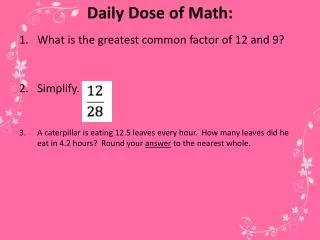
Daily Dose of Math: • What is the greatest common factor of 12 and 9? • Simplify. • A caterpillar is eating 12.5 leaves every hour. How many leaves did he eat in 4.2 hours? Round your answer to the nearest whole.
Comparing Fractions Similar Fractions: have the same denominator! common denominators! lowest common denominators! * My goal is... to use knowledge of the least common multiple and lowest common denominator to compare and order fractions.
Comparing Fractions Similar Fractions: have the same denominator! common denominators! lowest common denominators! * My goal is... to use knowledge of the least common multiple and lowest common denominator to compare and order fractions.
Comparing Fractions Similar Fractions: have the same denominator! common denominators! lowest common denominators! * My goal is... to use knowledge of the least common multiple and lowest common denominator to compare and order fractions.
Comparing Fractions Similar Fractions: have the same denominator! common denominators! lowest common denominators! * My goal is... to use knowledge of the least common multiple and lowest common denominator to compare and order fractions.
Least Common Multiple, or LCM, is the smallest multiple two or more numbers have in common. • The multiples of a number are all products that result in multiplying that number with the counting numbers.