Codequiry vs. Standard Plagiarism Checkers: The Key Differences
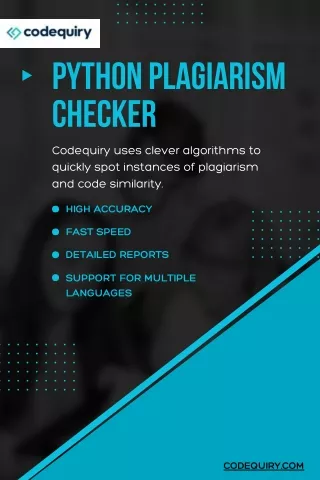
Traditional plagiarism checkers struggle with detecting code duplication accurately. Codequiry, an advanced code plagiarism checker, goes beyond basic text comparisons by analyzing code structure, logic, and modifications. Unlike standard tools, it detects even obfuscated or AI-generated code, ensuring originality and fairness. Whether for academics or developers, Codequiry provides precise, secure, and reliable plagiarism detection, setting a new standard in code integrity.


Codequiry vs. Standard Plagiarism Checkers: The Key Differences
E N D
Presentation Transcript
Codequiry vs. Traditional Plagiarism Checkers: What Makes It Unique? In programming, originality is not just a virtue—it’s a necessity. With an increasing number of developers, students, and organizations sharing and reusing code, the risk of plagiarism is higher than ever. While traditional plagiarism checkers primarily focus on textual content, a Code Plagiarism Checker like Codequiry is designed to analyze and compare source code much more deeply. The Limitations of Traditional Plagiarism Checkers Traditional plagiarism checkers work well for essays and research papers but fall short when applied to source code. These tools often rely on keyword matching and phrase similarity,
which do not e?ectively detect logical resemblances in programming. They may overlook restructured or slightly modified code, making them unreliable for developers and educators who need precise code comparisons. Moreover, basic plagiarism checkers fail to analyze logic and structure—two crucial aspects of programming. Code can be modified with simple tricks such as renaming variables, altering indentation, or changing comments while keeping the logic intact. Traditional tools cannot detect such manipulations, making them ine?ective for code-based plagiarism detection. How Codequiry Stands Out Codequiry Code Plagiarism Checker is specifically designed to detect code plagiarism and ensure originality with unmatched accuracy. Here’s what makes it unique: Advanced Code Analysis: Unlike traditional checkers, Codequiry uses deep structural analysis to detect similarities even when variable names, formatting, and structures are altered. Algorithm-Based Detection: Instead of relying on simple text-matching techniques, Codequiry uses robust algorithms like tokenization, abstract syntax tree (AST) analysis, and machine learning to identify logical similarities between code snippets. Multi-Language Support: Codequiry can analyze code in various programming languages, making it a versatile tool for developers, students, and institutions working with diverse technologies. Privacy and Security: Codequiry ensures that submitted code remains confidential and is not stored or reused, making it a trusted choice for professionals and educators. Seamless Integration: Ideal for academic institutions, software companies, and individual developers, Codequiry integrates smoothly into existing workflows, providing e?cient and accurate code comparison. Real-World Applications of Codequiry Codequiry’s Plagiarism Checker is widely used across multiple industries and academic environments: Educational Institutions: Professors and instructors use Codequiry to check student assignments for copied code, ensuring fair grading and academic integrity. Software Development Companies: Businesses utilize Codequiry to prevent unauthorized code reuse and protect proprietary algorithms from being copied. Freelancers & Open-Source Developers: Independent programmers leverage Codequiry to verify the originality of their work before submission or publication. Why Choose Codequiry?
A reliable Plagiarism Checker is essential for maintaining code originality, protecting intellectual property, and ensuring fair evaluations. Codequiry integrates the robust detection methods of the Moss Plagiarism Checker, refining and expanding upon its capabilities to deliver even greater accuracy. Unlike the Stanford Code Plagiarism Checker, which primarily focuses on structural similarity, Codequiry employs advanced algorithms, multi-language support, and deep structural analysis to detect even the most subtle code modifications. With Codequiry, users can trust that their code remains unique and secure. Whether for academic institutions, professional developers, or coding competitions, Codequiry provides an industry-leading solution to combat code plagiarism e?ectively. By combining the best aspects of Moss Plagiarism Checker and surpassing the limitations of traditional plagiarism tools, Codequiry stands as the ultimate choice for accurate, secure, and e?cient plagiarism detection. Protect Your Code’s Integrity Today! Don’t let plagiarism put your work at risk. With advanced AI code detection, Codequiry can identify AI-generated code, ensuring authenticity and originality. Use Codequiry to maintain trust, safeguard intellectual property, and uphold coding integrity.