Aqueous Solutions and Ionic Equations: Understanding Reactivity
80 likes | 147 Vues
Learn how to write Ionic Equations for reactions in aqueous solutions and predict precipitates using precipitation diagrams. Understand spectator ions and net ionic equations.


Aqueous Solutions and Ionic Equations: Understanding Reactivity
E N D
Presentation Transcript
Aqueous Solutions Write what is in the purple boxes
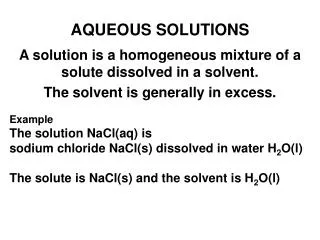
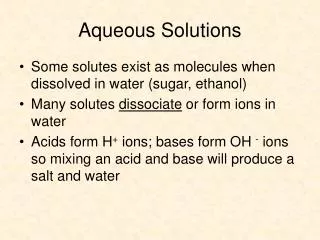
Ionic Equations • When a soluble substance is dissolved in water, the substance often breaks into ions. This solution is said to be an aqueous solution. • Pb(NO3)2(aq) Pb2+(aq)+ 2NO3-(aq) • NaI(aq) Na+(aq)+ I-(aq) An aqueous solution is ions dissolved in water
Ionic Equations • Consider the reaction… • Pb(NO3)2(aq) + 2NaI(aq) PbI2(s) + 2NaNO3(aq) • What is really going on is… • Pb2+ + 2NO3- + 2Na+ + 2I- PbI2(s) + 2Na+ + 2NO3- • Note that the Na+ ion and the NO3- ion are not reacting. They are said to be spectator ions.
Net Ionic Equations • It is often useful to write an equation showing only the species that are actually reacting. This is called a net ionic equation. It does not show the spectator ions. Pb2+ + NO3- + Na+ + 2I- PbI2(s) + Na+ + NO3- becomes…. Pb2+(aq)+ 2I-(aq) PbI2(s)
Precipitates • The solid formed from mixing two aqueous solutions is called the precipitate
To predict precipitates, use the Precipitation Diagram A solid box means a solid forms
Examples • NaOH(aq) + Cu(NO3)2(aq) • Na3PO4(aq) + Fe(NO3)3(aq) • MgSO4(aq) + AgNO3(aq) • KOH(aq) + NaNO3(aq)