Exploring Classical Mechanics: From Newton's Laws to Quantum Correspondence
This overview delves into classical mechanics, focusing on the study of motion through Newton's laws and conservation principles. It covers reference frames, including rotating and accelerated, and introduces Lagrangian and Hamiltonian formulations. Topics like orbital mechanics and rigid body motion are explored alongside oscillations and chaos theory. The link between classical and quantum mechanics is examined through the Correspondence Principle and various examples, such as the particle in a box and the hydrogen atom, emphasizing the transition from quantum to classical concepts.

Exploring Classical Mechanics: From Newton's Laws to Quantum Correspondence
E N D
Presentation Transcript
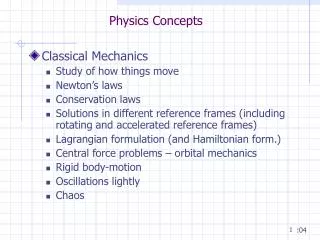
Physics Concepts • Classical Mechanics • Study of how things move • Newton’s laws • Conservation laws • Solutions in different reference frames (including rotating and accelerated reference frames) • Lagrangian formulation (and Hamiltonian form.) • Central force problems – orbital mechanics • Rigid body-motion • Oscillations lightly • Chaos :04
Mathematical Methods • Vector Calculus • Differential equations of vector quantities • Partial differential equations • More tricks w/ cross product and dot product • Stokes Theorem • “Div, grad, curl and all that” • Matrices • Coordinate change / rotations • Diagonalization / eigenvalues / principal axes • Lagrangian formulation • Calculus of variations • “Functionals” and operators • Lagrange multipliers for constraints • General Mathematical competence :06
Correlating Classical and Quantum Mechanics • Correspondence Principle • In the limit of large quantum numbers, quantum mechanics becomes classical mechanics. • First formulated by Niels Bohr, one of the leading quantum theoreticians • We will illustrate with • Particle in a box • Simple harmonic oscillator • Equivalence principle is useful • Prevents us from getting lost in “quantum chaos”. • Allows us to continue to use our classical intuition as make small systems larger. • Rule of thumb. System size>10 nm, use classical mechanics. :02
1-D free particle Classical Lagrangian and Hamiltonian for free 1-D particle Schroedinger’s equation for free particle :02
Hydrogen Atom Classical Lagrangian and Hamiltonian Schroedinger’s equation for hydrogen :02
Hydrogen Atom Schroedinger’s equation for hydrogen :02
Particle in a box N=1, no match between quantum and classical probability N=51, Averaged quantum probability approaches classical constant probability. :02
Expectation values Bra-ket notation and Matrix formulation of QM All wave functions may be written as linear combination of eigenfunctions. Thus effect of operator can be replaced by a matrix showing effect of operator on each eigenfunction. All QM operators (p, L, H) have real eigenvalues – They are “Hermitian” operators :02
Expectation values Bra-ket notation and Matrix formulation of QM All wave functions may be written as linear combination of eigenfunctions. Thus effect of operator can be replaced by a matrix showing effect of operator on each eigenfunction. All QM operators (p, L, H) have real eigenvalues – They are “Hermitian” operators :02
Spin Matrix :02
Wind up Classical mechanics is valid for In other words … almost all of human experience and endeavor. Use it well! :02