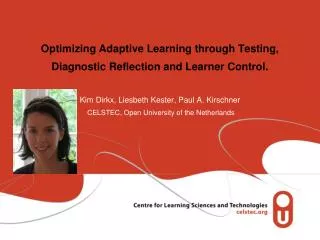
Enhancing Adaptive Learning with Diagnostic Testing and Learner Control
This paper explores the optimization of adaptive learning through the integration of testing, diagnostic reflection, and learner control. Authors Kim Dirkx, Liesbeth Kester, and Paul A. Kirschner from CELSTEC, Open University of the Netherlands, discuss the testing effect as detailed by Roediger and Karpicke (2006). They present data on how different learning activities affect retention intervals in both factual and general question tests, providing valuable insights for educational practices that promote better learning outcomes.

Enhancing Adaptive Learning with Diagnostic Testing and Learner Control
E N D
Presentation Transcript
Optimizing Adaptive Learning through Testing, Diagnostic Reflection and Learner Control. Kim Dirkx, Liesbeth Kester, Paul A. Kirschner CELSTEC, Open University of the Netherlands
The Testing Effect Roediger and Karpicke (2006)
Results Figure 1. The interaction between Learning Activity and Retention Interval on the verbatim factual test. Figure 2. The interaction between Learning Activity and Retention Interval on the general question test.