Understanding Gravity Erosion: Types, Causes, and Differences
This article explores the concept of gravity erosion, detailing its five primary types: landslides, mudslides, lahars, creeps, and rock falls. It explains the characteristics of each type, their mechanisms, and their impacts on the environment. Additionally, the text contrasts landslides and rock falls, highlighting the key differences between these mass movements. Concepts such as the angle of repose and the factors influencing slope stability are also discussed. Discover how gravity shapes our landscape through various erosional processes.

Understanding Gravity Erosion: Types, Causes, and Differences
E N D
Presentation Transcript
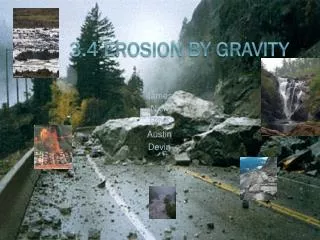
James Nick Ross Austin Devin 3.4 EROSION BY GRAVITY
What are the five types of gravity erosion? What is the difference between a landslide and a rock fall? Questions
Angle of Repose • The steepest slope, or angle, that rock won’t slide on. • The characteristics of the surface material, such as its size, weight, shape, and moisture level, determine at what angle the material will move downward.
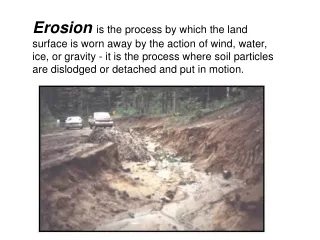
Rapid Mass Movement Rock Falls- a group of rocks that fall down a steep slope Landslides- the sudden movement of rock and soil down a steep slope Mudflows- the flow of a large amount of mud or rock and soil mixed with a large amount of water Lahars- mudflows of volcanic origin A landslide.
Slow Mass Movement. • Creep- the slow downhill movement of weathered rock material • Slow mass movements happen a little at a time. • More material is moved collectively over time. This is a large glacier Located in Argentina.
Questions/Answers • What are the five types of gravity erosion? The five types of gravity erosion are Landslides, Mudslides, Lahars, Creeps, and Rock Falls. • What is the difference between landslides and rock falls? • The difference between a landslide and a rock fall is that a landslide is the fast sudden movement of rocks / earth sliding down a steep hill where as a rock fall is when the rocks fall down a cliff in midair.