Download
1 / 1
10 likes | 101 Vues
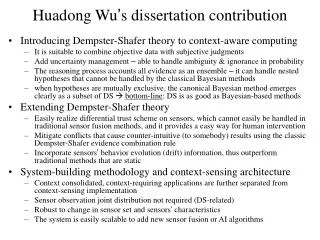
Huadong Wu's dissertation introduces the Dempster-Shafer theory to context-aware computing, combining objective data with subjective judgments and managing uncertainty. The reasoning process handles nested hypotheses and is robust to ambiguity and ignorance. Extending the theory allows for differential trust schemes on sensors, easy human intervention, conflict mitigation, and evolution information incorporation, outperforming traditional methods. The system-building methodology includes a context-sensing architecture robust to sensor changes and easily scalable for new algorithms.

E N D
Huadong Wu’s dissertation contribution • Introducing Dempster-Shafer theory to context-aware computing • It is suitable to combine objective data with subjective judgments • Add uncertainty management – able to handle ambiguity & ignorance in probability • The reasoning process accounts all evidence as an ensemble – it can handle nested hypotheses that cannot be handled by the classical Bayesian methods • when hypotheses are mutually exclusive, the canonical Bayesian method emerges clearly as a subset of DS bottom-line: DS is as good as Bayesian-based methods • Extending Dempster-Shafer theory • Easily realize differential trust scheme on sensors, which cannot easily be handled in traditional sensor fusion methods, and it provides a easy way for human intervention • Mitigate conflicts that cause counter-intuitive (to somebody) results using the classic Dempster-Shafer evidence combination rule • Incorporate sensors’ behavior evolution (drift) information, thus outperform traditional methods that are static • System-building methodology and context-sensing architecture • Context consolidated, context-requiring applications are further separated from context-sensing implementation • Sensor observation joint distribution not required (DS-related) • Robust to change in sensor set and sensors’ characteristics • The system is easily scalable to add new sensor fusion or AI algorithms