Understanding the Fundamentals of Life: Characteristics and Classifications
This overview explores the essential characteristics of life, highlighting that all living organisms are composed of cells, require energy, reproduce, display heredity, respond to their environment, maintain homeostasis, and evolve. It defines life according to various dictionaries and outlines the six kingdoms of living organisms: Archaea, Monera, Protista, Fungi, Plantae, and Animalia. Additionally, it explains the classification hierarchy, from kingdom to species, using examples such as lions and humans. The information is designed for educational purposes and provides valuable insights into biological classification.

Understanding the Fundamentals of Life: Characteristics and Classifications
E N D
Presentation Transcript
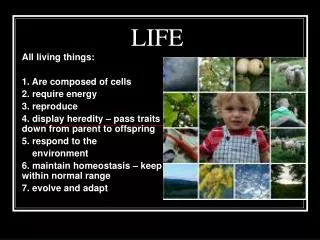
LIFE All living things: 1. Are composed of cells 2. require energy 3. reproduce 4. display heredity – pass traits down from parent to offspring 5. respond to the environment 6. maintain homeostasis – keep within normal range 7. evolve and adapt
LIFE DEFINITIONS • II. Some Definitions of Life: • Life: The property manifested in functions such as metabolism, growth, response to stimulation, and reproduction, by which living organisms are distinguished from dead organisms or from inanimate matter. (Webster's Dictionary) • Life: The state of being which begins with generation, birth, or germination, and ends with death; also, the time during which this state continues; that state of an animal or plant in which all or any of its organs are capable of performing all or any of their functions; used of all animal and vegetable organisms. (Gray's Medical Dictionary)
Classification - 6 Kingdoms • Archaeans • Monerans • Protists • Fungi • Plants • Animals
Archaeans • 1 cell • No true nucleus • Live in extreme environments • High temperatures • High salinity • High methane concentrations
KINGDOM MONERA (monerans) *1 cell *no true nucleus - prokaryote –*examples - bacteria, blue-green bacteria (cyanobacteria)
KINGDOM PROTISTA (protists) *1 cell *have a true nucleus – eukaryote *examples - amoeba, diatom, euglena, paramecium, some algae (unicellular), etc
KINGDOM FUNGI *multicellular *have nuclei*mainly do not move from place to place*heterotrophic – must get food (food is digested outside of fungus)*examples - mushroom, mold, puffball, shelf/bracket fungus, yeast, etc
KINGDOM PLANTAE (plants) *multicellular *have nuclei *do not move *autotrophic – makes own food *examples - multicellular algae, mosses, ferns, flowering plants (dandelions, roses, etc.), trees, etc
KINGDOM ANIMALIA (animals) *multicellular *have nuclei *do move *heterotrophic – must get food *examples - sponge, jellyfish, insect, fish, frog, bird, lion, humans
Classification • Kingdom – King • Phyllum – Philip • Class - came • Order – over • Family – for • Genus – good • Species – sphaghetti
Classification of living things • Kingdom - Animalia • Phylum - Chordata • Class - Mammalia • Order - Carnivora • Family - Felicidae • Genus - Panthera • Species – Leo • LION – Panthera Leo
Classification of Humans • Kingdom: Animalia Phylum: Chordata (Subphylum: Vertebrata)Class: MammaliaOrder: Primates Family: HominidaeGenus: HomoSpecies: sapiens Humans – Homo sapiens
BINOMIAL NOMENCLATURE • Scientific names - 2 name naming system • The genus and species name are used to name each species • Ex. Lion is Panthera Leo • Ex. Humans are Homo sapiens
Credits • http://anthro.palomar.edu/animal/table_humans.htm • http://www.usoe.k12.ut.us/CURR/Science/sciber00/7th/classify/sciber/5king2.htm • http://www.windows.ucar.edu/tour/link=/earth/Life/images/domains_lg_gif_image.html • http://www.astrographics.com/GalleryPrintsIndex/GP2110.html • http://plants.ifas.ufl.edu/guide/bacteria.html
Credits • http://www.ucmp.berkeley.edu/fungi/fungi.html • http://www.biotal.co.uk/beef/yeasts/yeasts.html • http://www.wssa.net/photo&info/NoEditWFP.htm • http://www.smugmug.com/community/PanaUsers/keyword/zoo • http://www.atpm.com/6.08/insects/