Download

1 / 25
250 likes | 356 Vues
This research delves into the determinants of stock and bond return comovements, focusing on fundamental factors using a dynamic factor model. It aims to establish stylized facts and understand the level and time variation in stock-bond return correlations. Key tasks include identifying economic state variables, shocks, and calculating model-implied correlations. The study investigates both fundamental and alternative explanations, such as flight-to-safety and consumer confidence, to explain residual correlations. Insights are drawn from a 4-factor model and analysis of constant versus time-varying betas. The findings highlight the significance of risk aversion and uncertainty in influencing stock-bond return correlations.

E N D
The Determinants of Stock and Bond Return Comovements Lieven Baele Tilburg University, CentER, Netspar Geert Bekaert Columbia University, NBER, CEPR Koen Inghelbrecht Ghent University
Research questions • Establish stylized facts with respect to stock-bond return correlations. • Explain level and time variation in stock-bond return correlations using dynamic factor model. Only fundamental factors are considered (but we consider wide range) • Consider non-fundamental instruments to explain any residual correlation.
Stylized Facts • Data: • NYSE-AMEX-NASDAQ value-weighted total excess returns from CRSP. • 10-Year excess Bond Returns from CRSP US Treasury and Inflation Module. • Unconditional Correlation:
Quarterly Conditional correlations Unconditional Correlation Ex-Post Correlation
In search for fundamentals: Explain average stock-bond correlation and its time variation through common exposures to economic state variables.
Methodology: intuition State of the Economy CF Uncertainty M Inflation Interest Rate Output Risk Aversion Bond Return Stock Return Comovement
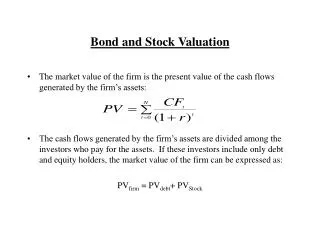
Dynamic Factor Model • Consider following model: Stock/Bond returns Expected Stock/Bond returns (Time-Varying) Factor Exposures Model Residuals Shock to economic State variable Diagonal factor VCV
Model Implied Correlations • The fundamental-implied correlation is given by: • Implications: • Correlations driven by Betas and Factor Variances. • Positive (negative) correlation if stock/bond betas have same (different) signs.
Task List Select relevant Economic State Variables Identify Shocks in State Variables Model Conditional Variance of State Variable Shocks Relate Fundamental Shocks to Stock-bond Returns Constant Factor Exposures Time-Varying Factor Exposures Calculate Model-Implied Stock-Bond Return Correlations
Identifying shocks in state variables • We need to identify unexpected shocks in the state variables. • For interpretational purposes, shocks also need to be pure, i.e. stripped of the effects of (shocks to) other state variables. • Two methods: • Standard Vector AutoRegressive model (VAR) • Structural New-Keynesian Model (structural VAR) • Imposes restrictions that come from economic theory • Parameters have ‘interpretation’. • Only for simple model with output, inflation, and interest rate as state variables.
Factor Volatility • The model for conditional factor volatility contains two building blocks: • A Regime-Switching Intercept • Lagged information variables • Example of three factor model: shifts variance of exogenous shocks shifts variance of monetary policy (interest rate) shocks
Some take-aways from our NK model estimates Smoothed Probability of being in High Volatility Regime
Constant vs Time-Varying Betas • Simple affine asset pricing models imply asset returns are constant beta functions of innovations in state variables. • We allow betas to vary through time, but put sufficient structure on betas to avoid picking up non-fundamental sources: • Duration Effects: Interest rate sensitivity increases with duration • Bonds: duration decreases with interest rate level. • Equity: duration decreases with level of dividend yield • Uncertainty:dispersion in beliefs increases the effect of economic shocks on returns (David and Veronesi (04)).
Summary of Fundamental Models • Best models explain some of time variation in S-B Correlations • Economically motivated models work better than a-theoretical VAR • Positive Correlations before Great Moderation, then zero to negative correlations. • Risk Aversion – Uncertainty are Key • Yet, even best models fails to fit both magnitude and timing • Our positive correlations are not positive enough. • Our switch to low (negative) correlations is too early • Our negative correlations are not negative enough.
Example: 4-factor model • Results from constant beta model: • Joint significance (blue) only for Fundamental Risk Aversion factor. • Comparable performance when Risk Aversion is replaced by economic uncertainty variables. • Allowing betas to vary through time improves fit with ex-post correlatons.
Alternative explanations #1 • We relate residual stock-bond return correlations to: • Flight-to-safety • Investors switch from the risky asset, stocks, to a safe haven, bonds, in times of increases stock market uncertainty. • Proxies: VIX Implied Volatility, Conditional equity volatility from statistical model. • Consumer Confidence • Consumer confidence may contain an additional component that proxies for particular behavioral biases. • We measure consumer confidence by the University of Michigan’s Consumer Sentiment Index.
Alternative explanations #2 • We relate residual stock-bond return correlations to: • Flight-to-Safety • Consumer Confidence • Cross-Market Liquidity Effects • Flight-to-Liquidity from Stocks to Bonds : Negative effect on stock-bond correlation. This effect is likely to be correlated with flight-to-safety. • Common Liquidity shocks (possibly monetary policy driven) : Positive shock to stock-bond correlations. • Bond liquidity measure based on quoted bid-ask spreads. • Equity liquidity measure based on proportion of zero daily returns/volumes.
Alternative explanations: Findings • Residual stock-bond return correlations... • Decrease when there are large shocks in equity market volatility • Consistent with flight-to-safety story. • Are unaffected by shocks to consumer confidence • Feature already captured by fundamental model. • Decrease when liquidity in equity market dries up • Consistent with flight-to-liquidity story. • Increase when liquidity dries up in both equity and bond market • Increase in liquidity risk premiums from common liquidity shock leads to lower returns in both markets, and hence positive correlations.
Conclusions • We give maximum flexibility for economic fundamentals to explain the time variation in stock-bond correlations: • Wide range of fundamentals. • Flexible specifications. • Despite flexibility, we do not get close to explaining the average/conditional level of stock-bond correlations. • Alternative (non-fundamental) explanations look more promising.
Future Work • How much do fundamental – non-fundamental factors explain of stock – bond return volatility? • Low versus high-frequency components in volatility and correlations. • Incorporate liquidity in the fundamental model. • Stock-bond correlations at different frequencies (daily -> 5 year) • International evidence • Surprising commonality in stock-bond return correlations across markets.