One-Year Clinical Outcomes of the RESOLUTE US Study: Evaluating R-ZES Effectiveness
The RESOLUTE US study assessed the clinical effectiveness of the Resolute zotarolimus-eluting stent (R-ZES) in 1,402 patients with de novo lesions in native coronary arteries. The primary endpoint was the 12-month target lesion failure (TLF) rate, which was 3.7% for R-ZES compared to 6.5% from historical data on the Endeavor zotarolimus-eluting stent (E-ZES), demonstrating noninferiority. Results indicate low clinical restenosis rates and minimal need for repeat revascularization, especially for patients with diabetes and small vessel sizes, but further long-term studies are warranted.

One-Year Clinical Outcomes of the RESOLUTE US Study: Evaluating R-ZES Effectiveness
E N D
Presentation Transcript
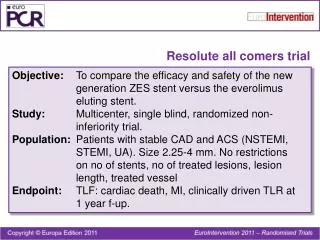
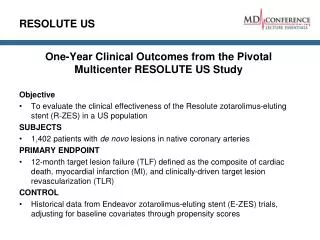
RESOLUTE US One-Year Clinical Outcomes from the Pivotal Multicenter RESOLUTE US Study Objective • To evaluate the clinical effectiveness of the Resolute zotarolimus-eluting stent (R-ZES) in a US population SUBJECTS • 1,402 patients with de novo lesions in native coronary arteries PRIMARY ENDPOINT • 12-month target lesion failure (TLF) defined as the composite of cardiac death, myocardial infarction (MI), and clinically-driven target lesion revascularization (TLR) CONTROL • Historical data from Endeavor zotarolimus-eluting stent (E-ZES) trials, adjusting for baseline covariates through propensity scores
RESOLUTE US • 12 Month Results • TLF was 3.7% in R-ZES versus 6.5% in historical E-ZES data • R-ZES met the 3.3% margin of noninferiority • Overall TLF rate was 4.7
RESOLUTE US Conclusions • Very low rate of clinical restenosis and low need for repeat revascularization that was achieved on very high compliance of dual antiplatelet therapy are reassuring for challenging patients with diabetes mellitus and small-sized vessels • Low rates of important clinical safety events, such as death, MI, and stent thrombosis (similar rates with R-ZES compared with earlier E-ZES) • Further trials are required to demonstrate long-term efficacy and safety of the R-ZES