Understanding Ionic Compounds: Naming, Formulas, and Charges of Metals
This comprehensive guide explores the essentials of ionic compounds, focusing on naming conventions, writing ionic formulas, and understanding the charges of representative elements and transition metals. It explains rules such as "Swap & Drop" for determining subscripts in compound formulas and the significance of Roman numerals for denoting variable charges in transition metals. Practical examples, including cations and anions, transition metal nomenclature, and learning checks, are provided to reinforce understanding. Ideal for chemistry students and enthusiasts.

Understanding Ionic Compounds: Naming, Formulas, and Charges of Metals
E N D
Presentation Transcript
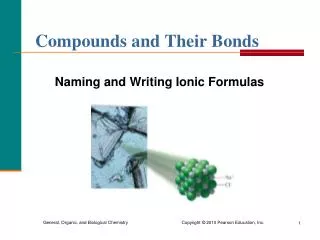
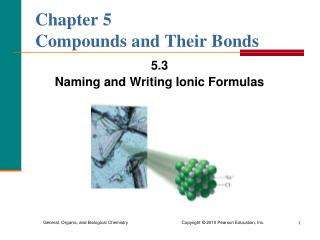
Unit 5BCompounds and Their Bonds Naming and Writing Ionic Formulas
What is this rule? Correct Wrong Na+ and Cl- = Na1Cl1 Mg2+ and Cl- = Mg2Cl1 Al3+ and Cl- = Al3Cl1 Ca2+ and P3- = Ca2P3 • Na+ and Cl- = NaCl • Mg2+ and Cl- = MgCl2 • Al3+ and Cl- = AlCl3 • Ca2+ and P3- = Ca3P2
Writing Ionic Formulas • Use Swap & Drop to get subscripts • Ions Formulas • cation anion • Na+ Cl- • K+ S2- • Mg2+ O2- • Ca2+ I- • Al3+ O2-
What is this rule? Correct Wrong Ca2+ and O2- = Ca2O2 Sn4+ and O2- = Sn2O4 Mg2+ and S2- = Mg2S2 • Ca2+ and O2- = CaO • Sn4+ and O2- = SnO2 • Mg2+ and S2- = MgS
Writing Ionic Formulas • Simplify the ratio of subscripts if possible.
What is this rule? Correct Wrong Iron (III) & O2- = Fe3O2 Tin (II) & Cl- = Sn2Cl Copper (II) & F- = Cu2F • Iron (III) & O2- = Fe2O3 • Tin (II) & Cl- = SnCl2 • Copper (II) & F- = CuF2
Writing Ionic Formulas • Transition metals can have more than 1 positive charge. • We use Roman numerals to designate the charge.
Learning Check Write the formulas and names for compounds of the following ions: Br− S2− N3− Na+ Al3+
Naming Variable Charge Metals Transition metals with two different ions use a Roman numeral after the name of the metal to indicate ionic charge.
Learning Check Select the correct name for each. A. Fe2S3 1) iron sulfide 2) iron(II) sulfide 3) iron(III) sulfide B. CuO 1) copper oxide 2) copper(I) oxide 3) copper(II) oxide
Solution Select the correct name for each. A. Fe2S3 3) iron (III) sulfide Fe3+ S2- B. CuO 3) copper (II) oxide Cu2+ O2-