SlideServe
Menu
Préférences
© SlideServe · v2026

### Strategies for Effective Reading of Informational Non-Fiction Books ###

cora-flores avatar
1 diapositives · 207 Views · Nov 28, 2014

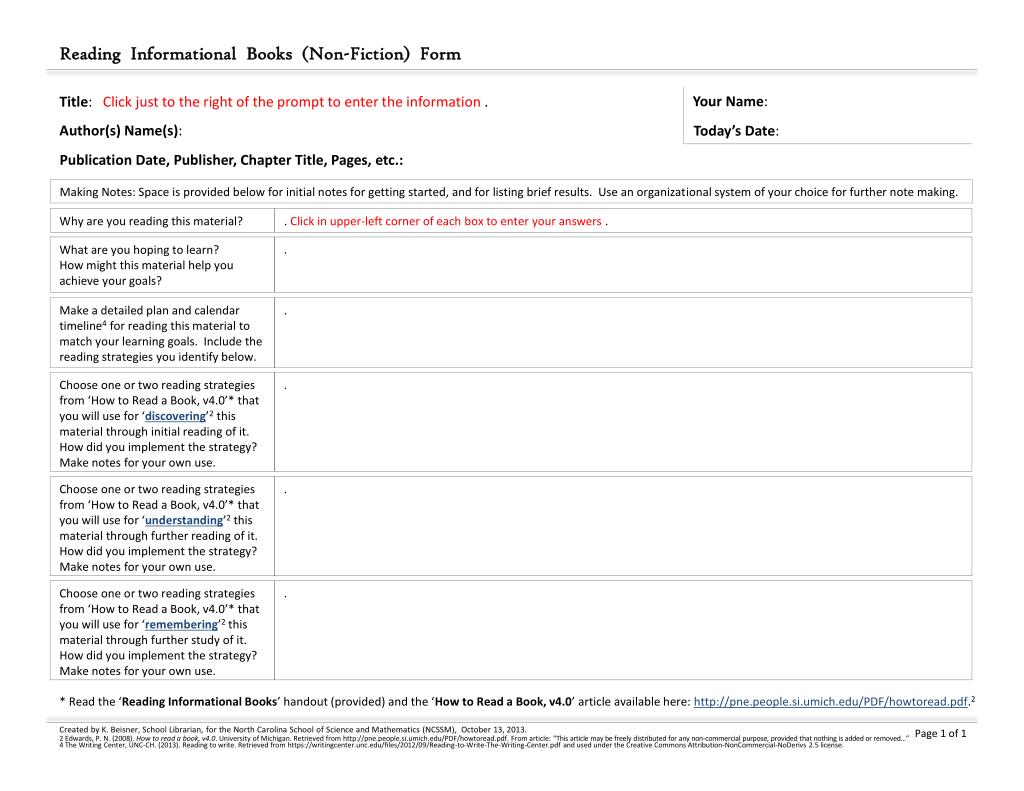
This guide outlines effective strategies for reading non-fiction informational books to enhance understanding and retention. It introduces organizational methods for note-taking, encourages setting clear learning goals, and provides actionable reading strategies. By selecting techniques outlined in "How to Read a Book," this resource empowers readers to approach material methodically, fostering deeper comprehension and memory. Use this plan to align your reading pace with your objectives, making your learning experience more structured and purposeful. ###
### 
Strategies for Effective Reading of Informational Non-Fiction Books

### - slide 1
01 / 1### Strategies for Effective Reading of Informational Non-Fiction Books ###
1 / 17

Télécharger la présentation

### Strategies for Effective Reading of Informational Non-Fiction Books ###
Une image / un lien ci-dessous est fourni (tel quel) pour télécharger la présentation

Politique de téléchargement : le contenu du site vous est fourni TEL QUEL pour votre information et votre usage personnel ; il ne peut être vendu, concédé sous licence ni partagé sur d’autres sites sans l’accord de son auteur.Le contenu vous est fourni TEL QUEL, pour votre information et votre usage personnel uniquement. Téléchargez la présentation en cliquant sur ce lien. Lors du téléchargement, si vous ne parvenez pas à télécharger une présentation, l’éditeur a peut-être supprimé le fichier de son serveur.Pendant le téléchargement, si vous ne parvenez pas à obtenir une présentation, le fichier a peut-être été supprimé par l’éditeur.

F I N

Plus de contenu associé

Transcription de la présentation
  1. Reading Informational Books (Non-Fiction) Form Your Name: Title: Click just to the right of the prompt to enter the information . Author(s) Name(s): Today’s Date: Publication Date, Publisher, Chapter Title, Pages, etc.: Making Notes: Space is provided below for initial notes for getting started, and for listing brief results. Use an organizational system of your choice for further note making. Why are you reading this material? . Click in upper-left corner of each box to enter your answers . What are you hoping to learn? How might this material help you achieve your goals? . Make a detailed plan and calendar timeline4 for reading this material to match your learning goals. Include the reading strategies you identify below. . Choose one or two reading strategies from ‘How to Read a Book, v4.0’* that you will use for ‘discovering’2 this material through initial reading of it. How did you implement the strategy? Make notes for your own use. . Choose one or two reading strategies from ‘How to Read a Book, v4.0’* that you will use for ‘understanding’2 this material through further reading of it. How did you implement the strategy? Make notes for your own use. . Choose one or two reading strategies from ‘How to Read a Book, v4.0’* that you will use for ‘remembering’2 this material through further study of it. How did you implement the strategy? Make notes for your own use. . * Read the ‘Reading Informational Books’ handout (provided) and the ‘How to Read a Book, v4.0’ article available here: http://pne.people.si.umich.edu/PDF/howtoread.pdf.2 Page 1 of 1 Created by K. Beisner, School Librarian, for the North Carolina School of Science and Mathematics (NCSSM), October 13, 2013. 2 Edwards, P. N. (2008). How to read a book, v4.0. University of Michigan. Retrieved from http://pne.people.si.umich.edu/PDF/howtoread.pdf. From article: “This article may be freely distributed for any non-commercial purpose, provided that nothing is added or removed…” 4 The Writing Center, UNC-CH. (2013). Reading to write. Retrieved from https://writingcenter.unc.edu/files/2012/09/Reading-to-Write-The-Writing-Center.pdf and used under the Creative Commons Attribution-NonCommercial-NoDerivs 2.5 license.