
Energy
E N D
Presentation Transcript
What is Energy? • Energy is the ability to cause change • Any time you move, or move something you are using energy
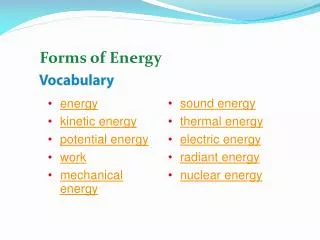
Forms of Energy • What are some forms of energy? • Electrical – energy in the form of moving electrons • Chemical – energy from a chemical reaction • Thermal – energy of heat • Radiant – the energy of electromagnetic waves including light, gamma rays, microwaves
Converting Energy • Energy can be converted between it’s different forms • Radiant Energy is converted to chemical energy through photosynthesis
Electrical energy is turned into radiant energy in a lightbulb.
Kinetic Energy • Kinetic energy is the energy of movement • KE = ½ mv2 • m is the mass of an object, v is the velocity of an object • Standard units – kg m2/s2 or Joules (J)
Example • A jogger who’s mass is 60 kg is moving at 3 m/s, what is the jogger’s kinetic energy? • m = 60 kg, v = 3 m/s • KE = 1/2(60kg)(3 m/s)2 = 270 J
Example • A car moving at a speed of 20 m/s has a KE of 300,000 J. What is the car’s mass?
Example • A sprinter has a mass of 62.5 kg and a KE of 4000 J. What is the sprinter’s velocity?
Potential Energy • Potential energy is stored energy • 5 Types of Potential Energy • Elastic • Chemical • Electrical • Nuclear • Gravitational
Elastic • Elastic Potential Energy is energy stored by something that can stretch or compress
Chemical • Chemical Potential Energy is the energy stored in the chemical bonds between atoms.
Electrical • Electrical Potential Energy is the energy due to the position of an electric charge
Nuclear • Nuclear Potential Energy is the energy stored in the nucleus of an atom • If you could release all of the nuclear potential energy in you body, you could power the United States for 6 years.
Gravitational • Gravitational Potential Energy is energy stored due to an object’s position above the Earth’s surface
Formula for Gravitational Potential Energy • PE = mgh • m is the mass of an object, g is the acceleration due to gravity, h is the height above the Earth • Standard units – kg m2/s2 or Joules (J)
Example • A 65 kg rock climber climbs a cliff. What is the climber’s potential energy when she is 35 m above the base of the cliff? • m=65 kg, h=35m, g=9.8 m/s2 • PE = mgh = (65kg)( 9.8 m/s2)(35m) = 22295 J
Example • What is the mass of a hiker 200 m above the ground if her GPE is 117600 J?
Example • Find the height of a baseball with a mass of .15kg and has a GPE of 73.5 J?
Kinetic or Potential • a moving skateboard, • a rock at the edge of a cliff, • an unconnected battery, • a baseball being pitched, • a gallon of gas, • a stretched rubber band, • a moving car, • a person climbing stairs • a pizza
Energy can change forms • What happens when you turn on a lightbulb? • What happens to the lightbulb if you leave it on for a long time?
Conversions • Mechanical energy is the total amount of kinetic and potential energy in a system. • ME = KE + PE
Law of Conservation of Energy • Law of Conservation of Energy – energy can not be created or destroyed, only transformed.