Download

1 / 9
100 likes | 280 Vues
Discover the principles behind Newton's Universal Law of Gravity, which states that every body attracts every other body with a force proportional to their masses and inversely proportional to the distance separating them. This concept leads to an understanding of weight and weightlessness, notably illustrated by astronauts in orbit. Dive into the mechanics of satellite motion, characterized as high-speed projectiles that continuously fall around the Earth due to the balance of gravitational pull and tangential velocity. Explore how these celestial bodies maintain their orbits in a virtually resistance-free environment.

E N D
Physics: SatellitesCh. 14 Ms. Goldamer
The Universal Law of Gravity • Newton was not the first to discover gravity. Newton discovered that gravity is universal. • Legend—Newton, sitting under an apple tree, realized that the force between Earth and the apple is the same as that between moons and planets and everything else.
Law of universal gravitation • everything pulls on everything else. • Every body attracts every other body with a force that is directly proportional to the product of their masses and inversely proportional to the square of the distance separating them.
Weight and Weightlessness • Weight is the force an object exerts against a supporting surface. • examples: standing on a scale in an elevator accelerating downward, less compression in scale springs; weight is less.
Weight continued • standing on a scale in an elevator accelerating upward, more compression in scale springs; weight is greater. • at constant speed in an elevator, no change in weight.
Weightlessness • Weightlessness = no support force, as in free-fall. • example: astronauts in orbit are without support forces and are in a constant state of weightlessness.
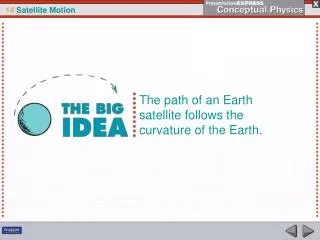
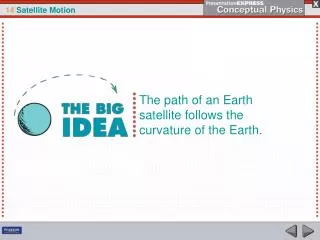
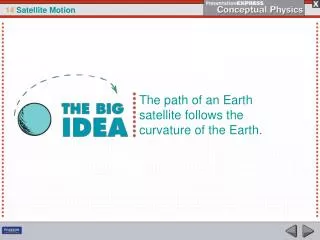
Fast-Moving Projectiles—Satellites • satellite motion is an example of a high-speed projectile .
Satellites are Projectiles • a satellite is simply a projectile that falls around Earth rather than into it. – sufficient tangential velocity needed for orbit – with no resistance to reduce speed, a satellite goes around Earth indefinitely.
Circular Satellite Orbits • Positioning- beyond Earth’s atmosphere, where air • resistance is almost totally absent .