The Six Kingdoms
The Six Kingdoms. Terms to Know. Number of Cells. Unicellular One cell. Multicellular More than one cell. How it Eats. Autotroph Makes it’s own food from the sun ( auto matically). Heterotroph Must eat other plants or animals for food. Nuclei. Prokaryote No nucleus . Eukaryote

The Six Kingdoms
E N D
Presentation Transcript
Number of Cells • Unicellular • One cell • Multicellular • More than one cell
How it Eats • Autotroph • Makes it’s own food from the sun (automatically) • Heterotroph • Must eat other plants or animals for food
Nuclei • Prokaryote • No nucleus • Eukaryote • Has a true nucleus
Can it Move? • Sessile • Can’t move • Mobile • It can move
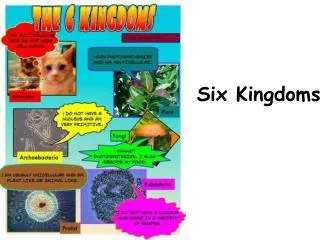
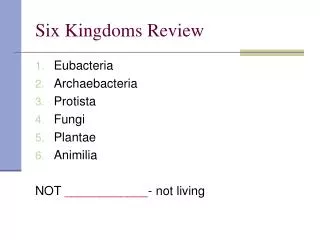
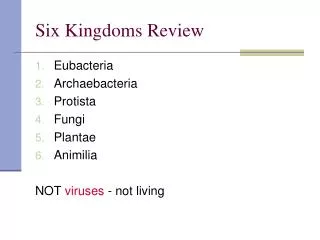
6 Kingdoms • Based on cell type, structure, nutrition • All Bacteria are Eubacteria • All Archaea are Archaebacteria • Eukarya contains: Protista, Fungi, Plantae, Animalia
Kingdom Eubacteria • Bacteria are the most abundant type of organism • Prokaryotes – they have a cell wall but no nucleus (simple organism)
Characteristics - Eubacteria • Come in many different shapes • Can move • Unicellular • No nucleus or organelles
Characteristics - Eubacteria • Eating habits • Heterotrophic • Autotrophic (just a few) • Can survive in many environments • Aerobic (oxygen) • Anaerobic (no oxygen)
Kingdom Archaebacteria • Most scientists believe Archaea to be more ancient than bacteria. • Main Difference: type of material used for cell wall
Characteristics- Archaebacteria • Unicellular • Many shapes • Some autotrophic, most heterotrophic
Extremophiles • Extremophiles – they live in the most extreme environments on Earth • Hot springs • Salty lakes • Thermal vents on ocean floor • Acidic stomachs
Kingdom Protista – The Misfits • Don’t fit into any other category • Aren’t similar to each other either. • 3 categories • Plantlike protists • Animal-like protists • Funguslikeprotists
Plantlike Protists • Autotrophic, perform photosynthesis • Algae • Sea Kelp • Red Algae
Euglenoids • Euglenoids – have both plantlike and animal-like characteristics • Perform photosynthesis so usually grouped with plantlike protists
Animal-like Protists • Heterotrophic • Do not form organs • Protozoans • amoebas
FunguslikeProtists • Decomposes dead organic material, resembles real fungi • Slime molds and mildews
Characteristics – Kingdom Fungi • More than 70,000 species • Eukaryotes, absorbs nutrients from organic materials in it’s environment • All are heterotrophs and decomposers • They secrete digestive enzymes into their food source and then absorb the nutrients directly into their cells
Special Characteristics - Fungi • They are sessile (they can’t move) • Rigid cell walls • Have hyphae • Threadlike strands that enable the fungi to grow, feed, and reproduce
Characteristics – Kingdom Plantae • The base of all land habitats - 250,000 species • Autotrophs - make energy from the sun through photosynthesis • A few are heterotrophs
Plants • Multicellular • Cell walls contain cellulose • Can’t move - sessile • Are organized into tissues • Most have organs such as roots, stems, and leaves
Characteristics – Kingdom Animalia • Heterotrophs • Multicellular • Eukaryotic • Have membrane- bound organelles
Animals – Innards • No cell walls • Cells are organized into tissues • Most have tissues that are organized into organs (i.e. skin, stomach, brain) • Organs are often organized into complex systems (i.e. digestive, circulatory)
Animals - Diverse • Range widely in size • Live in water, on land, and in the air • Most can move • Some can’t (i.e. coral can’t move as an adult)
An exception to every system… • A virus is a nucleic acid that is surrounded by a protein coat
Viruses • Viruses have their own classification system • Not considered to be living • They are not cells and do not have cells