
Service-Learning: Engaging Students in Community Service for Learning Outcomes
E N D
Presentation Transcript
Service-Learning is… • a teaching method. • includes community service that addresses a community need. • enhances curricular goals and meets learning outcomes goals. • includes critical, reflective thinking. • develops students sense of civic responsibility and commitment to the community.
Faculty Support • Faculty Consultations • Creating an integrated SL curriculum • Workbook • community partnerships • Finding community partners • Connecting your teaching to research and scholarship • Service-Learning Faculty Work Group • Connect with SL practitioners in your discipline/college • Assistance with: • risk management • financial needs • recording service-learning hours
Finding Partnerships: • Collaborate with staff in the Service-Learning & Volunteer Programs department • Use OSLVP Website • Look for opportunities in the “Service Corner” • Send students to the Volunteer Fair • Partner with on-going programs at WCU
Volunteer Fair • September & February • 11am-2pm • Sykes Ballrooms Meet 55+ non-profit organizations to learn about volunteer opportunities!
Service Corner Sign up for our newsletter!www.wcupa.edu/volunteer Sent via email bi-weekly!
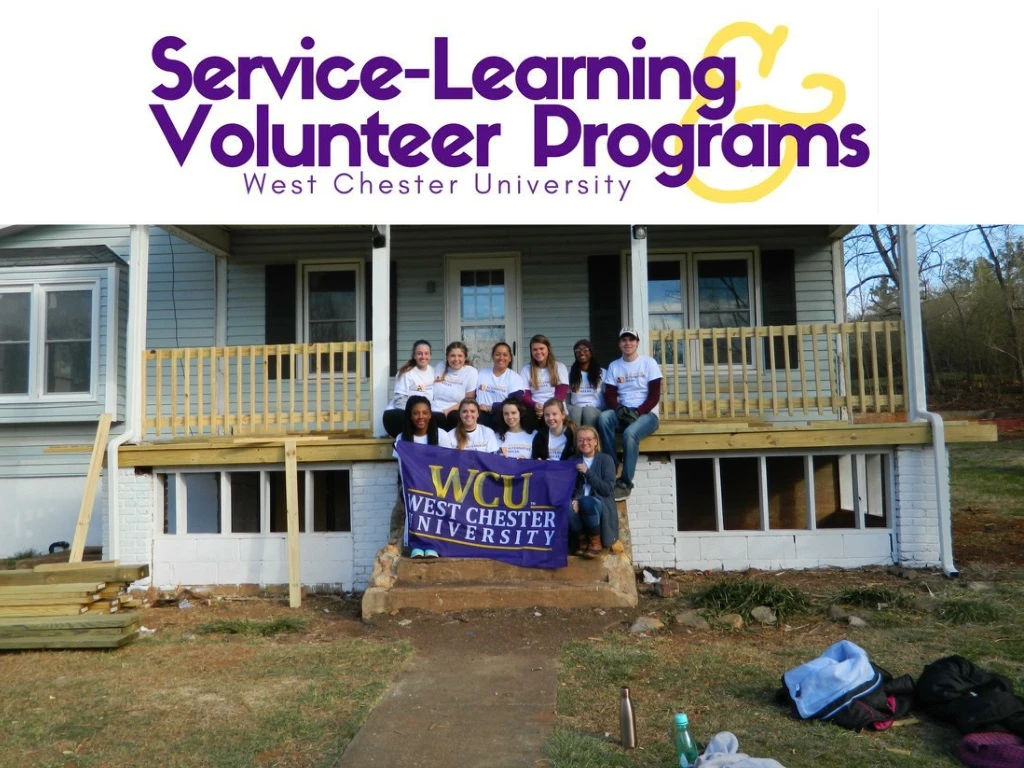
Examples of SL Projects Projects can be: • One-time or multi-part • Individualized or group-project based • During class-time or outside of class time Specific Examples: • Launch a voter engagement and registration drive • Create marketing materials for non-profits • Work across generations with seniors • Volunteer at MLK Day of Service or during MLK Legacy Week • Volunteer at the campus gardens and Gordon Natural Area • Be an ELS conversation partner • Use academic content area to solve a community need • Arts/Geography – Creating a mural or map of the US or globe at a local elementary school • Education – Literacy night at a local library/community center/school • STEM – Assist with a science fair for the Girls Scouts
Reflective Assignments • Journals: Writing in journals is widely used by service-learning programs to promote reflection. They're most meaningful when instructors pose key questions for analysis. • Multimedia Class Presentations: Students create a video or photo documentary on the community experience. • Theory Application Papers: Students select a major theory covered in the course and analyze its application to the experience in the community. • Agency Analysis Papers: Students identify organizational structure, culture and mission. • Presentations to Community Organizations: Students present work to community organization staff, board members, and participants. • Group Discussion: Through guided discussion questions, have students critically think about their service experiences. • Reflective Reading: Find articles, stories, or songs that relate to the service experience and create discussion questions that link the reading to the service-learning. • E-Portfolio: Any written assignments or videos could be included in the e-portfolio.
Key Points & Best Practices • Establish partnerships early • Clearly relay expectations to students at the beginning of the semester • Create ample opportunity for reflection that links student service to learning outcomes and community impact
Examples of Student Learning Outcomes • Communication: Students will be able to use verbal and/or written communication skills to address community issues and/or advocate for social change. • Critical and Analytical Thinking: Students will be able to critically reflect on the connections between academic content and community engagement. • Interdisciplinarity: Students will demonstrate the ability to use interdisciplinary knowledge to address community problems. • Diversity: Through community engagement students will develop knowledge of and sensitivity to issues of culture, diversity, and/or social justice. • Ethical Choices: Students will utilize ethical decision-making to meet community needs.
Contact Information Ashlie Delshad, Ph.D. Associate Professor, Political Science Service-Learning Faculty Associate Ruby Jones Hall, Room 206 610-738-0580 Adelshad@wcupa.edu Jodi Roth-Saks, M.A. Director, Service-Learning and Volunteer Programs Lawrence Center, Room 241 610-436-3379 JRoth@wcupa.edu www.wcupa.edu/volunteer