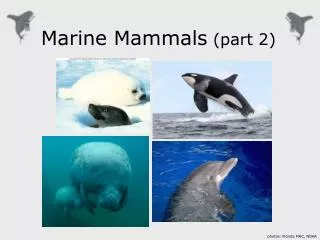
Marine Mammals (part 2)
510 likes | 951 Vues
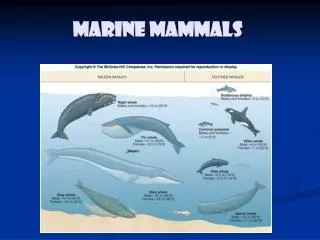
Marine Mammals (part 2). photos: Florida FWC, NOAA. Whales and Dolphins. Phylum Chordata Subphylum Vertebrata Class Mammalia Order Cetacea Suborder Mysticeti (baleen whales) Suborder Odontoceti (toothed whales, dolphins). Cetaceans. Entirely aquatic life


Marine Mammals (part 2)
E N D
Presentation Transcript
Marine Mammals (part 2) photos: Florida FWC, NOAA
Whales and Dolphins • Phylum Chordata • Subphylum Vertebrata • Class Mammalia • Order Cetacea • Suborder Mysticeti (baleen whales) • Suborder Odontoceti (toothed whales, dolphins)
Cetaceans • Entirely aquatic life • All marine except 5 species of freshwater dolphins • Streamlined, fish-like body (convergent evolution)
Cetaceans • Dorsal fin • 2 flippers • Tail – 2 flukes, horizontal • Blowhole – nostril(s) on top of head for breathing air
Cetaceans ← 2 blowholes in baleen whales (blue whale) NOAA 1 blowhole in toothed whales → (bottlenose dolphin)
Cetaceans • Rear limbs in embryos, fail to develop • Blubber for insulation, buoyancy • Almost completely hairless • Most closely related to hippos
Baleen Whales • Baleen • Flexible, fibrous plates • Not teeth, but keratin (like hair, nails) NOAA
Baleen Whales • Largest animals on earth • Eat: • Plankton (krill, copepods) • Small fish (herring, mackerel) • Benthic amphipods
Baleen Whales • Blue whale • Largest animal ever • 25 ft, 3 tons at birth • Up to 110 ft, 200 tons • Heart = 0.5 tons • Blood = 5000 gallons • Tongue = 3 tons • Eat 4+ tons of krill/day 1 ton = 2000 lbs http://oregonstate.edu/groups/marinemammal/images/bluebeagle2a.jpg http://www.pbs.org/wnet/nature/files/2008/06/image_krill.jpg http://channel.nationalgeographic.com/channel/content/kingdom-of-the-blue-whale-3302/blue-whale-facts/#/compare/length
Baleen Whales Blue whale (Balaenoptera musculus) http://www.whale-info.com/images/blue_whale.jpg http://upload.wikimedia.org/wikipedia/commons/1/14/BlueWhaleSkeleton.jpg
Baleen Whales Other rorquals NOAA Fin (Balaenoptera physalus) Sei (Balaenoptera borealis) NOAA Minke (Balaenoptera acutorostrata)
Baleen Whales Humpback (Megaptera novaeangliae) photos: NOAA
Baleen Whales → Northern Right (Eubalaena glacialis) → NOAA Bowhead (Balaena mysticetus) →
Baleen Whales • Seek fish schools, plankton swarms • Some concentrate and trap the food in bubble nets (humpback) NOAA http://physics.bu.edu/neppsr/PICS-2006/Whales/WhaleW_bubbleNet.jpg http://www.myfourthirds.com/files/0734/1Two_Humpbacks.jpg
Baleen Whales • Gulp, side feeding (rorquals: blue, fin, sei, minke) • Skimming (right, bowhead) • Bottom feeding (gray) http://www.whalecenter.org/sightings/images/rightwhale11_04.jpg http://www.arkive.org/media/E9/E9E81C14-0462-44DF-ACF0-D9A98C782F99/Presentation.Large/photo.jpg http://oregonstate.edu/groups/marinemammal/images/MPBlueSurfPleats.jpg http://oregonstate.edu/groups/marinemammal/images/Grey%20underwater2.jpg
Baleen Whales • Migrations – cold waters to feed, warm waters to breed
Toothed Whales • Predators • Use teeth to catch prey: • Fish • Squid • Seals, other whales (orcas) • Tear or swallow whole (don’t chew)
Baleen vs. Toothed Whales NOAA http://www.acsonline.org/merchandise/booksPosters/images/poster-comparisonChart-lg.jpg
Toothed Whales • Largest – sperm whale (“Moby Dick”) • Dive to over 7000 ft, stay over an hour NOAA
Toothed Whales • Hunt giant deep-sea squid, fish http://i.dailymail.co.uk/i/pix/2009/10/28/article-1223501-06FDA23C000005DC-677_634x444_popup.jpg
Beluga Whales NOAA http://www.sooke.org/tourism-photo-file/animals/belugabubble5.jpg
Narwhals • Same family as belugas, also live in Arctic • Have only 2 teeth – one becomes spiral tusk http://www.narwhal.info/cgi-bin/displayit2.cgi/images/Photos
Killer Whales (Orcas) NOAA NOAA NOAA http://www.mersea.com/Resident%20Orca.jpg
Pilot Whales NOAA NOAA http://www.mammalogy.org/mil_images/images/mid/930.jpg http://users.wsg.net/bedrosian/images/PilotWhale.jpg
Dolphins and Porpoises NOAA • Both are small toothed whales • Names sometimes used interchangeably • Porpoise – Family Phocoenidae, blunt-nosed, spade-shaped teeth • Dolphin – Family Delphinidae, beaked snout, pointed teeth
Dolphins NOAA Bottlenose Spotted NOAA Dusky Striped http://www.teara.govt.nz/NR/rdonlyres/B60F305D-F498-4F26-A8AE-C6FD23C028D3/139512/p4672pc.jpg http://gallery.photo.net/photo/1813171-md.jpg
Dolphins Indo-Pacific Humpbacked Atlantic White-Sided NOAA Peale’s Tucuxi (Amazon and coastal Brazil) photos: http://csiwhalesalive.org/csigallery.html
Long Island Cetaceans • Fin – most common baleen whale to LI • Nearshore (1 mi.) in winter • Farther (30 mi.) in spring, summer • Farthest (shelf edge) in fall • Humpback – sometimes shallow • Northern Right • Minke • Sei http://www.cresli.org/cresli/images/finmap.jpg
Long Island Cetaceans Humpback whale – 30 ft long, 13 tons East Hampton, April 6-9, 2010 http://cdn.newsday.com/polopoly_fs/1.1849475.1270648954!/image/2958831293.jpg_gen/derivatives/display_600/2958831293.jpg http://cdn.newsday.com/polopoly_fs/1.1854723.1270909443!/image/4150419117.JPG_gen/derivatives/display_600/4150419117.JPG
Long Island Cetaceans Humpback whale – 20 ft long New York Harbor, April 8-10, 2009 http://assets.nydailynews.com/img/2009/04/10/alg_humpback.jpg http://www.newsday.com/media/photo/2009-04/46100856.jpg
Long Island Cetaceans • Sperm whale • Pilot whale • Harbor porpoise • NW Creek, near Sag Harbor: • Common dolphins, Jan. 2007 (8 survived, 12 died) • Atlantic white-sided, Sep. 2007 (3, 1 died?) Google Maps http://www.riverheadfoundation.org/images/uploads/Dd_creek2.jpg
Swimming and Diving • Blue and killer whales – up to 30 mph • Dolphins bow-riding – up to 40 mph NOAA NOAA http://csiwhalesalive.org/csigallery.html
Swimming and Diving • Water vapor in warm breath – spout NOAA NOAA
Swimming and Diving • Rapid breaths (empty and refill lungs in seconds) • Efficient O2 exchange (90% vs. 20% in humans) Oxygen storage: • High blood volume • High conc. red blood cells • High conc. hemoglobin • Muscles rich in myoglobin • Heart rate slows • Blood flow to non-essential areas reduced • Lungs colapse, exhale to prevent “bends”
Echolocation • Excellent vision, but also have sixth sense (sonar) • High frequency clicks for close range • Low frequency sounds for long range NOAA
Vocalization • Sound travels 5 times faster in water than air • Low frequency calls/songs travel miles • Some sounds common to species, others specific to individals and pods • Used for breeding (males do the singing), feeding, alarm, maintaining contact
Intelligence http://home.onemain.com/~dk1008206/html/dolph1-1.gif
Behavior • Breaching • Spying • Assisting injured • Stranding
Reproduction http://www.spawar.navy.mil/sandiego/technology/mammals/Images/research/breed_6.jpg
Hunting • Long Island whaling: • Peaked in 1840’s • Sag Harbor – largest port (60 ships) • Also Greenport, Cold Spring Harbor Google Maps
Other Perils http://newsimg.bbc.co.uk/media/images/39154000/jpg/_39154790_net_bbc_203.jpg