Download
1 / 8
80 likes | 200 Vues
The Program on Networked Governance, led by Prof. David Lazer at Harvard, focuses on leveraging the problem-solving capacities of diverse agents through collaborations like colloquia and joint symposia. Key research areas include knowledge sharing among public health officials, optimizing connections between Congress members and the internet, and the dynamics of communication within teams. Supported by notable grants, this program investigates the trade-offs in collaboration and the impact of communication structures on problem-solving effectiveness. Explore insights from leading scholars in digital governance.

E N D
David Lazer The Program on Networked Governance
Program on Networked Governance • Programming: colloquia, joint symposia with National Center for Digital Government at UMass Amherst (Jane Fountain), videoconferenced trans- Atlantic events with ETH Zurich and University of Amsterdam • Fellows: Thomas Langenberg, Alexander Schellong, Birgit Rabl, Allan Friedman • Research: DNApolicy.net, Team-network project, Connecting to Congress, Public Health officials • www.ksg.harvard.edu/netgov • Supported by NSF grant 0131923. Author: Prof. David Lazer, Director, david_lazer@harvard.edu
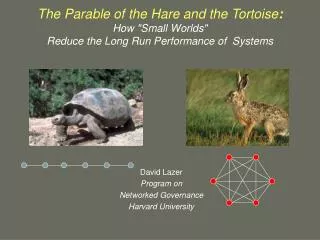
The Problem of Parallel Problem Solving • Many agents working on similar problems. • How to harness the problem solving capacity of many agents. • Common issue in computer science (optimization algorithms), not much in social sciences. • Trade-off: avoiding re-invention of wheel, while encouraging experimentation. Author: Prof. David Lazer, Director, david_lazer@harvard.edu
Connecting to Congress • Collaborators: Kevin Esterling (UCR), Michael Neblo (OSU), Ines Mergel • Looking at the use of the Internet by Members of Congress • Why is potential underutilized? • What personal networks are critical to supporting use of computer networks? • Supported by NSF grant # 0429452. Author: Prof. David Lazer, Director, david_lazer@harvard.edu
Collaborators: Ines Mergel, Maria Binz-Scharf Use of Internet to facilitate knowledge sharing in geographically dispersed community What are the obstacles (psychological, institutional) to asking and answering questions? Supported by NSF grant 0131923 and the Ash Institute. DNApolicy.net Author: Prof. David Lazer, Director, david_lazer@harvard.edu
Collaborator: Nancy Katz (Harvard) What communication patterns within and outside of team help it perform well? What role do the different media play in communications? Why do people choose the media that they do? Supported by grants from the Center for Public Leadership and the Women and Public Policy Program. Teams and Networks Author: Prof. David Lazer, Director, david_lazer@harvard.edu
State Health Officials • Collaborators: Ines Mergel, Nancy Katz • Knowledge Sharing in dispersed community of practitioners (one SHO per state) • How does knowledge of experienced SHO’s get transferred to new SHO’s • Supported by RWJF. Author: Prof. David Lazer, Director, david_lazer@harvard.edu
The dark side of making the world smaller • Collaborator: Allan Friedman • How does altering communication structure affect parallel problem solving? • Method: simulations • Preliminary answer: more communication can improve short run performance but at the expense of long run performance. • See paper at www.ksg.harvard.edu/netgov. • Supported by NSF grant 0131923. Author: Prof. David Lazer, Director, david_lazer@harvard.edu