Download
1 / 59
590 likes | 708 Vues
This work explores how "small worlds" in networked systems can diminish long-term performance, despite providing quick solutions. By examining the dynamics of parallel problem solving, the research highlights the role of informational diversity and network structure in shaping systemic outcomes. Drawing on models of agent-based decision-making, the findings illustrate how the balance between exploration and exploitation is affected by network architecture, velocity of communication, and the ruggedness of problem space. Understanding these dynamics is crucial for effective governance and organizational performance.

E N D
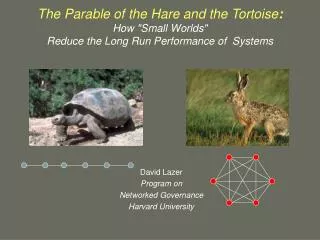
The Parable of the Hare and the Tortoise:How "Small Worlds" Reduce the Long Run Performance of Systems David Lazer Program on Networked Governance Harvard University
Acknowledgements… • Allan Friedman • NSF grant 0131923
Living in the (self-consciously) networked age • Growth of research on networks across disciplines • We live in an “smaller world” with ever-accelerating flows of information • Explosion of consultants, software, etc to make organizations “smaller”
The problem of parallel problem solving in human systems • Many agents working on same problem simultaneously • How is that problem solving aggregated?
Roadmap • The role of informational diversity in systemic performance • Networks as architecture for experimentation • Description of model • Results • Conclusion
Role of informational diversity • Sunstein, Nemeth, etc. • Informational diversity provides the menu of options in the system • However: pressures toward homogeneity, some of which may increase system performance (e.g., the elimination of bad solutions)
Processes of emulation • Neo-institutionalism– strong pressures for conformity (DiMaggio and Powell) • Networks play a key conduit for those pressures (Lazarsfeld, Friedkin, Lazer) • Convergence often not on system “optimum”, even when emulation is driven by success (Bikhchandani, Hirshleifer, and Welch; Strang and Macy)
Network structure • Cliquish • Small world– “six degrees of separation” (Milgram, Watts) • Birds of a feather (Lazarsfeld and Merton) • “Scale free” (Barabasi) • how does the architecture of the network affect balance between exploration and exploitation?
Small worlds (Milgram, Watts and Strogatts) Big world Small world
Network structure • Cliquish • Small world– “six degrees of separation” (Milgram, Watts) • Birds of a feather (Lazarsfeld and Merton) • “Scale free” (Barabasi) • how does the architecture of the network affect balance between exploration and exploitation?
Computational model • KISS principle– simplest possible model that captures some essence of reality • Agent-based– decision rules dictating agent behavior based on local conditions (not analytically tractable) • “Experimentally” manipulate parameters, test for robustness • Key question: what systemic patterns emerge?
Model • Problem space– what’s the problem agents are trying to solve? • Agent decision rules– how do agents seek improvements in performance? • Agent neighborhood– who do agents see (and emulate)?
Problem space • Key attribute of problem space is its ruggedness
Problem space • NK model (Kauffman) • N dimensions (19 in these simulations) • The marginal contribution of each dimension to performance is contingent on K other dimensions • K determines the ruggedness of the problem space (5 in most of these simulations) • Scores are calculated using a rank-preserving monotonic transformation
Decision rule • Capacity of agents to search problem space must be very limited
Decision rule • If someone agent can see is doing better than agent at time t, copy best alternative. • Otherwise, look at impact of randomly changing one dimension. If this is an improvement, move there. If not an improvement, stay at previous solution.
Informational velocity • Always looking at others? • If not: • Is communication synchronous (e.g., group meetings)? • Is communication asynchronous?
Network– determines neighborhood Linear (max degrees of separation = population size – 1) Fully connected (max degrees of separation = 1)
Basic model parameters • 100 agents • 200 time steps • 1000 simulations of each experiment • 20 NK spaces (N = 19, K = 5) • 50 randomly seeded starting points • Vary size, network structure, velocity, and synchronicity Code written in Java using the Repast libraries
Findings • Size • Network structure • Velocity • Synchronicity
The hare and the tortoise:Small worlds are good for a quick fix…