
SlideServe
Menu
Préférences
© SlideServe · v2026

Understanding Key Roots and Their Meanings: A Lexical Exploration

craig avatar
25 diapositives · 406 Views · Sep 19, 2014

This compilation delves into various roots and their associated words, illustrating the intricate connections between language and meaning. Each root is explored through key terms that demonstrate its significance, such as "Cantor" for vocal roles in religion, "Chiropractor" related to hand healing, and "Photosynthesis," describing light-based processes. Understanding these roots enhances vocabulary and comprehension, while providing insights into the evolution of language. This guide serves as a resource for students, educators, or anyone interested in the building blocks of language.
Understanding Key Roots and Their Meanings: A Lexical Exploration - slide 1
01 / 25Understanding Key Roots and Their Meanings: A Lexical Exploration
1 / 17

Télécharger la présentation

Understanding Key Roots and Their Meanings: A Lexical Exploration
Une image / un lien ci-dessous est fourni (tel quel) pour télécharger la présentation

Politique de téléchargement : le contenu du site vous est fourni TEL QUEL pour votre information et votre usage personnel ; il ne peut être vendu, concédé sous licence ni partagé sur d’autres sites sans l’accord de son auteur.Le contenu vous est fourni TEL QUEL, pour votre information et votre usage personnel uniquement. Téléchargez la présentation en cliquant sur ce lien. Lors du téléchargement, si vous ne parvenez pas à télécharger une présentation, l’éditeur a peut-être supprimé le fichier de son serveur.Pendant le téléchargement, si vous ne parvenez pas à obtenir une présentation, le fichier a peut-être été supprimé par l’éditeur.

F I N

Plus de contenu associé

Transcription de la présentation
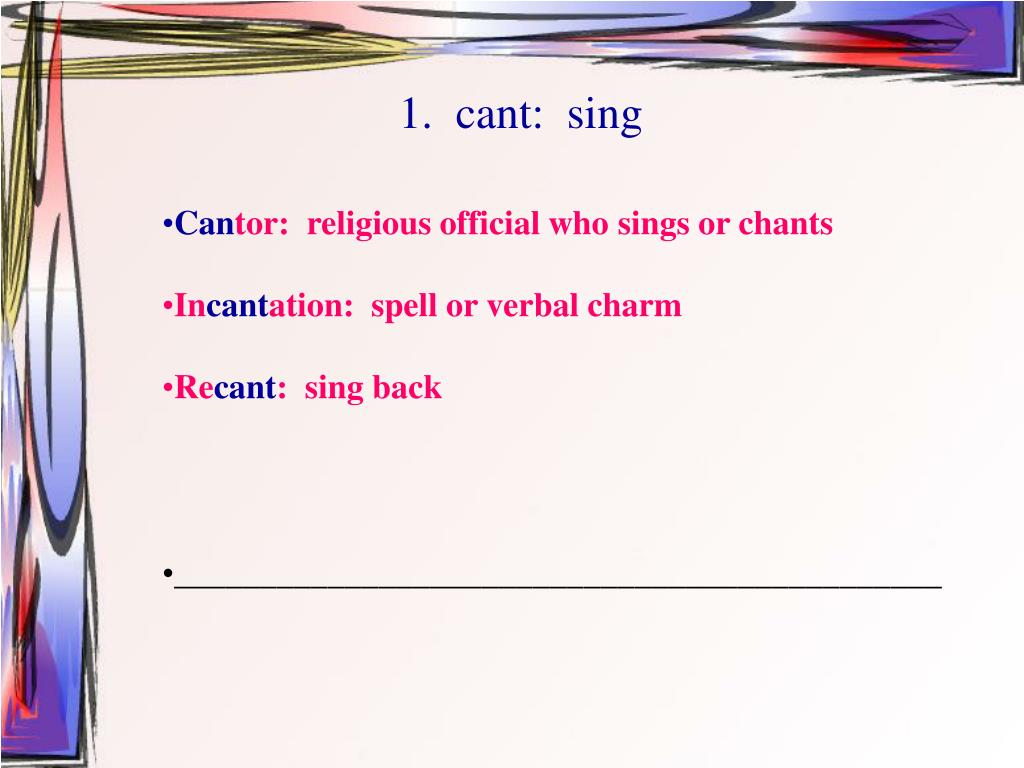
  1. 1. cant: sing • Cantor: religious official who sings or chants • Incantation: spell or verbal charm • Recant: sing back • _____________________________________________

  2. 2. Carp: fruit • Acarpous: sterile; not bearing fruit • Carpophagous: feeding on fruit • Sarcocarp: fleshy fruit like apricot or cherry • __________________________________________

  3. 3. Caust: burn • Caustic: corrosive; sarcastic • Cauterize: to burn with a hot instrument • Holocaust: total devastation by fire; a sacrificial offering • consumed by fire • ___________________________________________

  4. 4. Cephal: head • Bicephalous: full of two heads • Cephalopod: a marine mollusk that has a distinct head • with tentacles around the mouth and well-developed eyes, • like the octopus and the squid • Electroencephalograph: an instrument to record electric • currents in the brain ___________________________________________

  5. 5. Chiro: hand • Chirography: handwriting, penmanship • Chiropractor: one who uses his/her hands to heal • Backs • Chiromancy: palm reading • _____________________________________________

  6. 6. De (div): god • Deity: a god • Deify: to make a god • Divine: pertaining to god • _________________________________________

  7. 7. Em (emp): buy, take • Example: from the latin exemire, to take out • Peremptory: take thoroughly; ending all debate • Caveat emptor: “Let the buyer beware!” • __________________________________________

  8. 8. Fil: line, thread • File: a receptacle that keeps loose objects in line • Filament: a thinly spun thread, fiber, or wire • Filigree: delicate, intricate, ornamental work • made from gold, silver, or other fine wire • ____________________________________________

  9. 9. Gyro: circle, turn • Gyration: act of turning • Gyrocopter: a rotary-wing aircraft that is driven • forward by a conventional propeller • Gyrocompass: a navigational device containing a gyroscope • with a rotating axis parallel to the earth’s axis and thus • pointing to true north instead of magnetic north • __________________________________________

  10. 10. Hibern: winter • Hibernate: the act of holing up for the winter • Hibernal: pertaining to winter • Hibernaculum: a case, covering, or structure in which an • Organism remains dormant during the winter • _________________________________________

  11. 11. Journ: daily • Journal: related to daily • Journey: a day’s travel • Journeyman: one who has completed his apprenticeship, or • a day’s work • _______________________________________

  12. 12. Lumin: light • Luminous: full of light • Illuminate: to put light into • Luminescence: beginning to be light • ___________________________________________

  13. 13. My (myo): muscle • Cardiomyopathy: disease of the heart muscle • Myasthenia: abnormal muscle fatigue or weakness • Myogenic: forming muscle tissue • ________________________________________

  14. 14. Pend (pens): hang, weigh • Pending: characteristic of hanging • Pensive: characteristic of weighing something in one’s • mind • Depend: to hang down • __________________________________________

  15. 15. Phor: bear, yield, carry • Euphoria: state of yielding something good • Dysphoria: state of yielding bad things • Carpophore: bearing fruit • ________________________________________

  16. 16. Put: think • Compute: to think together • Dispute: to think apart • Reputation: what people think about someone • __________________________________________

  17. 17. Radic (radix): root • Radical: characteristic of root • Radish: root vegetable • Eradicate: to get rid of completely; root out • ____________________________________

  18. 18. Rat (ratio): reason, think, determine • Rational: characteristic of reason • Ratify: to confirm or make settled • Ratiocinate: to think methodically and logically • ___________________________________________

  19. 19. Rid (ris): laugh, mock • Ridiculous: laughable • Deride: laugh down • Ridicule: mock • _____________________________________

  20. 20. Scend: climb • Ascend: climb to or toward • Descend: climb down • Transcend: climb across • ____________________________________________

  21. 21. Spor: sow • Endospore: spore formed within the cell membrane of • a parent cell • Sporocide: an agent of killing spores • Sporogenesis: formation of or reproduction by spores • __________________________________

  22. 22. Stat (stasis): stand, stop, stable • Static: inactive, not moving • Thermostat: maintains a stable present temperature • Hemostasis: stoppage of blood flow by natural or surgical • means • ________________________________________

  23. 23. the: put • Photosynthesis: process of putting light together • Epithet: put over or upon; a term, frequently abusive, • Used to characterize a person or thing • Antithesis: direct contrast; put against • ___________________________________________

  24. 24. Trop: turn • Tropic: circle at which the sun turns • Trophy: a monument to victory when the enemy turns • Heliotrope: turn toward the sun • ___________________________________________

  25. 25. Ver: true • Verify: make sure something is true • Verdict: speak the truth • Verisimilitude: state of being truly similar • _______________________________________