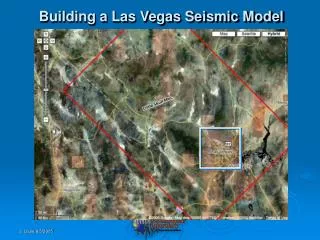
Building a Las Vegas Seismic Model
60 likes | 175 Vues
This study presents a seismic model for the Las Vegas Basin, focusing on the effects of deep volcanic rifts, particularly near Little Skull Mountain. Utilizing geophysical and geological data, the model generates an amplification map showcasing maximum ground motion computed at 0.5 Hz. The analysis reveals complex patterns of ground motion amplification influenced by basin depth and geological features. Findings highlight the importance of shallow re-entrant basins in converting Rayleigh-wave energy into Love-wave energy, emphasizing the unique seismic characteristics of the basin's edges.


Building a Las Vegas Seismic Model
E N D
Presentation Transcript
Deep Volcanic Rifts Las Vegas Basin Little Skull Mtn. Model Rendered as Amplification Map • Geology, Basin Depth, Geotech, Geophysical data into ModelAssembler
Deep Volcanic Rifts Las Vegas Basin Little Skull Mtn. Max. Ground Motion Computed– 0.5 Hz • E3D elastic finite-difference solution, by Shawn Larsen, LLNL
LVV GM Pattern Computed at 0.5 Hz • Raw maximum horiz. motion is “speckly” (left) • Smooth to clarify streaks (arrows, right); geological input to grid is smooth
LVV GM Pattern Origin in Basin Depth? • GM pattern in LVV (left) does not resemble basin-depth map (right) • Some GM amplification at steep walls of basin on north and east (circled)
LVV GM Pattern Origin in Basin Edges? • Complexities in the basin edges– re-entrants of shallow basins into the bedrock (circles)– concentrate conversion of Rayleigh-wave energy in the bedrock to Love-wave energy in the re-entrants, which channels down the small valleys and “beams” across the main basin. • This effect is highly source, path, and basin dependent. • The re-entrant basins need only be ~100 m deep. Inspiration from Bill Stephenson, GNS Soil Dynam. Earthquake Eng. 25 (2005) 187-196