Understanding Atomic Structure: Bohr Models and Isotopes in Chemistry
This lesson focuses on the structure of the atom, particularly the Bohr model and isotopes. Students will draw the Bohr model for Titanium (Ti) and explore how to position electrons around the nucleus based on atomic structure. The session includes the history of the atom, a quiz, and Cornell notes on atomic components such as protons, neutrons, and electrons. Students will also practice creating carbon isotope models and gain insights into the periodic table, atomic number, and atomic mass, furthering their understanding of chemical elements.

Understanding Atomic Structure: Bohr Models and Isotopes in Chemistry
E N D
Presentation Transcript
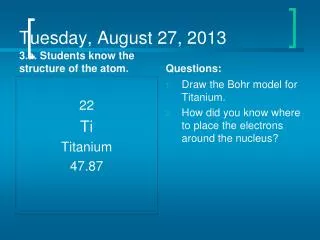
Tuesday, August 27, 2013 3.a. Students know the structure of the atom. Questions: Draw the Bohr model for Titanium. How did you know where to place the electrons around the nucleus? 22 Ti Titanium 47.87
Today’s Agenda • Journal • History of the Atom Quiz • Cornell Notes – The Atom • Carbon Isotopes Model • IP: Protons, Neutrons, and Electrons WS and Finish Cornell Notes
chlorine nitrogen silver gold mercury oxygen hydrogen helium sodium niobium neodymium carbon
Elements • Science has come along way since Aristotle’s theory of Air, Water, Fire, and Earth. • Scientists have identified 90 naturally occurring elements, and created about 28 others.
Elements • The elements, alone or in combinations, make up our bodies, our world, our sun, and in fact, the entire universe.
Key to the Periodic Table • Elements are organized on the table according to their atomic number, usually found near the top of the square. • The atomic number refers to how many protons an atom of that element has. • For instance, hydrogen has 1 proton, so it’s atomic number is 1. • The atomic number is unique to that element. No two elements have the same atomic number.
What’s in a square? • Different periodic tables can include various bits of information, but usually: • atomic number • symbol • atomic mass • number of valence electrons • state of matter at room temperature.
Atomic Number • This refers to how many protons an atom of that element has. • No two elements, have the same number of protons. Bohr Model of Hydrogen Atom Wave Model
Atomic Mass • Atomic Mass refers to the “weight” of the atom. • It is derived at by adding the number of protons with the number of neutrons. This is a helium atom. Its atomic mass is 4 (protons plus neutrons). What is its atomic number? H
Atomic Mass and Isotopes • While most atoms have the same number of protons and neutrons, some don’t. • Some atoms have more or less neutrons than protons. These are called isotopes. • An atomic mass number with a decimal is the total of the number of protons plus the average number of neutrons.
Carbon Isotope Chart • Copy and complete the chart above into your notes.
Atomic Mass Unit (AMU) • The unit of measurement for an atom is an AMU. It stands for atomic mass unit. • One AMU is equal to the mass of one proton.
Atomic Mass Unit (AMU) • There are 6 X 10²³ or 600,000,000,000,000,000,000,000 amus in one gram. • (Remember that electrons are 2000 times smaller than one amu).
Symbols • All elements have their own unique symbol. • It can consist of a single capital letter, or a capital letter and one or two lower case letters. C Carbon Cu Copper
Carbon Isotope Models • We are going to practice making Bohr models and demonstrate our understanding of isotopes, by creating carbon isotope models.
You Will Need • One yellow paper as background. • One sheet of “Parts of an Atom” • One index card for summary. • Scissors • Glue
Procedure • Copy the completed carbon isotope chart from your notes onto the top of the yellow paper. • Cut out the parts of the atom and make three complete Bohr models, one for each model (make sure you label it). Be creative but accurate! • On the index card, write a summary about what isotopes are (5-7 sentences) and staple it to the bottom.
Protons, Neutrons, and Electrons Independent Practice: Protons, Neutrons, and Electrons Finish Cornell Notes