100 120
This document outlines the suggested optimal amounts of amplification primer for various average-sized template DNAs, supported by data from the University of Oklahoma Genome Center. Results from a recent amplicon run indicate the efficient loading of beads and the resulting quality of sequence reads. A total of 1,232,028 reads were obtained, providing an average read length of 362 bases. The findings validate that both ~500 bp and ~300 bp fragment sets cover the full length of their respective amplicons, contributing valuable insights for future sequencing projects.

100 120
E N D
Presentation Transcript
100 120 University of Oklahoma Genome Center
100 120 150 University of Oklahoma Genome Center
The line was extrapolated from 3 data points, 100, 120 and 150 ul of amplification primer 100 120 130 140 150 University of Oklahoma Genome Center
Suggested Optimal Amount of Amplification Primer (ul) for Various Average Sized Template DNAs (bp) University of Oklahoma Genome Center
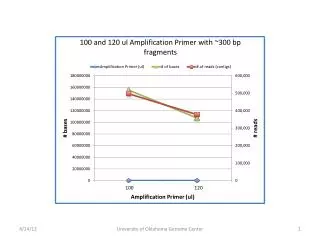
Most recent amplicon sequencing results • For this amplicon run: • we loaded 1800K beads made from a mixture of amplicons of ~300 and ~500 bases each (see slide 5) on each half of the plate (3600K beads total) using 100 ul of amplification primer on one half and 120 ul of amplification primer on the other half. • This run yielded 1,232, 028 reads that passed the filter, with 445,121,246 total bases for an average read length of 362 bases/read. • The average read length for each of the 4 sample sets is shown on the next slide. University of Oklahoma Genome Center
Average Read length for ~500 and ~300 bp fragments We conclude that both sets of sequence reads cover the full length of the respective amplicons University of Oklahoma Genome Center
Read length distribution for 1 kb genomic DNA fragments University of Oklahoma Genome Center