Implementing Tries in RAM for Efficient Data Retrieval
Learn how to efficiently implement tries in RAM for data retrieval. Understand the structure of nodes and pointers, search strategies, and handling blockages. Explore a practical example and references for further reading.

Implementing Tries in RAM for Efficient Data Retrieval
E N D
Presentation Transcript
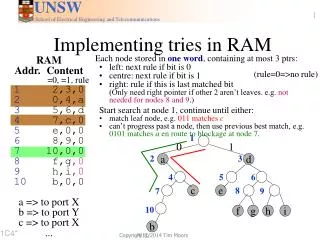
Implementing tries in RAM RAM Addr. Content =0, =1, rule 1 2,3,0 2 0,4,a 3 5,6,d 4 7,c,0 5 e,0,0 6 8,9,0 7 10,0,0 8 f,g,0 9 h,i,0 10 b,0,0 a => to port X b => to port Y c => to port X ... (rule=0=>no rule) Each node stored in one word, containing at most 3 ptrs: • left: next rule if bit is 0 • centre: next rule if bit is 1 • right: rule if this is last matched bit(Only need right pointer if other 2 aren’t leaves. e.g. not needed for nodes 8 and 9.) Start search at node 1, continue until either: • match leaf node, e.g. 011 matches c • can’t progress past a node, then use previous best match, e.g. 0101 matches a en route to blockage at node 7. 1 0 1 2 3 a d 4 5 6 8 7 9 c e 10 f g h i b 9751C4* 4/11/2014 Tim Moors
21 21 3 21 3 21 35 35 7 7 21 7 21 7 51 51 35 9 35 9 54 12 35 54 7 33 7 35 54 7 7 14 7 6 6 e.g. Multi-bit variable-stride trie 128.252.153.160 1000 0000 1111 1100 1001 1001 1010 0000 35 0000 step 1 step 2 step 3 step 4 35 68 0010 35 35 0100 35 35 0110 35 35 1000 1010 1 1100 35 14 35 1110 35 35 Slide by V. Sivaraman based on example from D. Taylor et al: 'Scalable IP lookup for programmable routers', Proc. Infocom, pp. 562-71, 2002 9751DE* 4/11/2014 Tim Moors