NCSX Vacuum Vessel Stress Analysis - FDR Fred Dahlgren
620 likes | 649 Vues
Comprehensive finite element analysis conducted by Fred Dahlgren to verify and ensure the design criteria and adequacy of the NCSX vacuum vessel. Material properties and structural considerations included.


NCSX Vacuum Vessel Stress Analysis - FDR Fred Dahlgren
E N D
Presentation Transcript
NCSX Vacuum Vessel Stress Analysis FDR Fred Dahlgren 17 May 2004
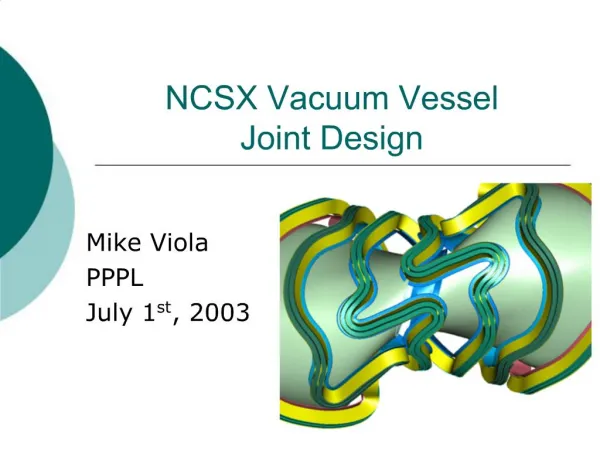
NCSX Vacuum VesselStress Analysis - FDR Fred Dahlgren Art Brooks Peter Titus NCSX Final Design Review May 19-20, 2004 PPPL
Purpose of analysis: To varify the adequacy of the vessel design and assure the design criteria are met. • Method: Finite element analysis using MSC/Nastran, Static(sol 101), Buckling(sol 105),Thermal(sol 153). • Assumptions: -Vessel & port configuration as of 2 April ‘04 Pro-E models (based on Se121-011 ver.94). -Material of shell & port nozzles and cover plates fabricated from Inconel 625 Annealed – Grade 1 sheet per ASTM B 443. -Material properties (Linear elastic, isotropic material properties) taken from the Huntington Alloys International Inconel 625 product bulletin. -Rigid vertical structural support to eliminate rigid body modes. -Preliminary static model runs assumed isothermal, 1-g gravity, 1 Atmosphere external pressure @14.7psi. Subsequent runs include nominal thermal distribution during bakeout conditions. -Disruption loads are derived from Spark ver.20b inductive solutions for a stationary center plasma and a plasma displaced 10 cm vertically up from its central equilbrium position.
Material Properties(@ 200 deg.C - 392 deg.F): -Youngs Modulus 28.7e6 psi -Shear Modulus 11.1e6 psi -Poissons’ Ratio 0.286 -Density 0.305 lbs/cu. in. -Coeff. of Thermal Exp. 7.3e-6 in./in.-deg.F • Material Properties (@ 400 deg.C – 750 deg.F): -Youngs Modulus 27.1e6 psi -Shear Modulus 10.5e6 psi -Poissons’ Ratio 0.294 -Density 0.305 lbs/cu. In. -Coeff. of Thermal Exp. 7.6e-6 in./in.-deg.F (From Huntington Alloys/Specialty Metals publication for Inconel 625)
Values from Pro-E Model used Material Thicknesses & port diameters for VV model ( inches): Part Thickness diameter Shell 0.375 Port 2 0.125 Port 3 0.125 Port 4 0.500 Port 6 0.250 Port 7 0.125 Port 8 0.125 Port 9 0.125 Port 10 0.125 Port 11 0.125 Port 12 0.500 Port 15 0.125 RF-Turret 0.188* Port 17 0.125 Port 18 0.125 Main Flange Dimensions: 0.65 wide x 0.85 deep, 0.375 weld
NCSX VACUUM VESSEL NASTRAN 120 DEG. FEA MODEL Model Details: 38,906 DOF’s 7782 GRID POINTS 7,228 CQUAD4 1,018 CTRIA3 40 MPC’s 4 SPC’s Boundary Conditions: Cylic-Symmetry @ welded edge via MPC’s, vertically fixed @ top clevis, circumferentially top & bot. of NB port Normal Operating Loads: Uniform external 14.7 psi Gravity – 1g Temperature 200 deg.C (max.) Bakeout: 400 deg.C (max) Off-Normal (EM Disruption) Loads: 320kA Plasma @ 1.7T 210kA Plasma @ 2.0T (High Beta) 320kA Plasma @ 1.7T @dZ=10cm (Inductively coupled solutions) MPC’s (cyclic-symm.)
DISPLACEMENTS FOR 1 ATMOSPHERE LOADING Run 120bbe3: 1 Atmosphere External Pressure Only
Peak Shell Displacement .125” Run 120bbe3: 1 Atmosphere External Pressure Only
Peak Tresca Stress @ Vertical Restraint 18 ksi Run 120bbe3: 1 Atmosphere External Pressure Only
Peak Tresca Stress @Outer Surface Z2 15.2 ksi Run 120bbe3: 1 Atmosphere External Pressure Only
Run 120bbe3: Tresca Stresses in the flange and weld areas are 1 to 7 ksi
Added 3rd Rib .5 x 1” high Added 2 Ribs .5 x 1” high Attempts to stiffen the shell locally – not very effective
Peak shell deflection 0.085 for 0.5” thk. Shell & 1 Atmosphere Load
Run 120bbe3g – 1 Atmosphere External Pressure + 1g Gravity Loading
1” typ. Port-9 0.375 Port-2 Max. displacements less than 0.088” Shell Reinforcement Added internal reinforcing Tee ribs Run 120bbe2a-tribsf
Peak Stress @ turret/shell 20.9 ksi Stress @ Support 18.3 ksi Tresca Stress From 1 Atmosphere + Gravity Loading Run 120bbe3g – 1 Atmosphere External Pressure + 1g Gravity Loading
A cantilevered load, at various port ends, was applied via a concentrated weight of 500lbs to simulate a 250lb load at the end of the port extension ( 2x length =2x load) * Actual port end deflection with the port extension will be higher (~4x for 2x length). Max. deflection* 1.26” Run 120bbe3gf Cantilevered Loading Of Ports
34.2ksi Tresca Stress Outer Surface (Z2) Tresca Stress From 500lb Cantilevered Load on Port Ends Run 120bbe3gf – 1 Atmosphere External Pressure + 1g Gravity Loading + 500lbs cantilevered
Inner Surface Tresca Stress 46.8 ksi Due To 500lb Cantilevered Load @ port18/turret intersection Run 120bbe3gf – 1 Atmosphere External Pressure + 1g Gravity Loading + 500lbs cantilevered
Tresca Stress reduced below 22ksi In the turret and weld region Stress & deflection still high but below allowables in Port 18 nozzle root 27.3ksi - ~1” displacement @end Increase nozzle thickness to .188”? Run 120bbegf-2 with turret wall 0.375” thick
Nominal bakeout temperature distribution: 400 deg.C uniform shell, 150 deg.C @ Port Flanges Run 120bbe2a-Thermal4 – Steady State Bakeout
Total Displacements due to bakeout temperatures: 400 deg.C shell 150 deg.C at port flanges Run 120bbe2a-tstress4 – Thermal Displacements
X-dir. Displacements due to bakeout temperatures: 400 deg.C shell 150 deg.C at port flanges Run 120bbe2a-tstress4 – Thermal Displacements
Displacements for gravity, pressure, and bakeout temperatures: 400 deg.C shell 150 deg.C @ port flanges Run 120bbe2a-tstress4 – Thermal + Pressure + Gravity Displacements
Tresca Stress Z1 Inner Surface due to gravity, pressure, and bakeout temperatures, 400 deg.C shell 150 deg.C at port flanges Run 120bbe2a-tstress4 – Thermal + Pressure + Gravity
Tresca Stress Z2 Outer Surface due to gravity, pressure, and bakeout temperatures, 400 deg.C shell 150 deg.C at port flanges Run 120bbe2a-tstress4 – Thermal + Pressure + Gravity
Buckling Eigenvalue = 12.99 - for 1 Atmosphere loading Run 120bbe3-buckle – Pre-load: 1 Atmosphere, Eigenvalue extraction method: Lanczos
Buckling mode shape local displacement between ports 9 & 2 Run 120bbe3-buckle
Poor CTRIA3 element orientation Run 120bbe3-buckle Reoriented elements produced higher critical load factor ~ 15.7 Run 120bbe2a-buckle
Disruption loading (Static Runs): • VDE – 320kA plasma @ 1.7 Tesla displaced 10 cm upward • Ohmic – 320kA plasma @ 1.7 Tesla • High Beta – 210kA plasma @ 2 Tesla Note: These disruptions are assumed to occur instantaneously and utilize the fully inductive SPARK solution
Force Distribution From VDE-UP(Self Forces) – 1.7 Tesla, 320kA Plasma Current Stationary @ 10cm
Force Distribution From VDE-UP(External Field Forces) – 1.7 Tesla, 320kA Plasma Current Stationary @ 10cm
Peak Inner Wall Shell Displacement: 0.20” Peak Outer Wall Shell Displacement: 0.25” Total Displacements Due to VDE-UP Eddy Currents + Atmospheric Pressure + Gravity Loads Run: 120bbe2a-VDE
22.2 ksi Peak Stress 17.6 ksi Tresca Stresses-Z1 (outer) Shell Surface For VDE-UP Eddy Currents + Atmospheric Pressure + Gravity Run: 120bbe2a-VDE
17.1 ksi 18.2 ksi Peak Tresca Stresses-Z2 (inner) Shell Surface For VDE-UP Eddy Currents + Atmospheric Pressure + Gravity Run: 120bbe2a-VDE
Peak Stress 27.6ksi Peak Tresca Stresses-Z2 @ Flange For VDE-UP Eddy Currents + Atmospheric Pressure + Gravity Run: 120bbe2a-VDE
Peak Stress 22.2ksi Peak Tresca Stresses-Z1 @ Flange For VDE-UP Eddy Currents + Atmospheric Pressure + Gravity Run: 120bbe2a-VDE
Force Distribution From OHMIC(Self Forces) – 1.7 Tesla, 320kA Plasma Current Stationary
Force Distribution From OHMIC (External Field Forces) – 1.7 Tesla, 320kA Plasma Current Stationary
Peak Port Displacement: 0.358” Peak Displacements Outer Wall: 0.185” Peak Displacements Inner Wall: 0.130” Displacements Due to Ohmic Disruption Run: 120bbe2a-OHMIC
Peak Stress 13.6 ksi Tresca Stresses-Z1 (Outer) Surface For Ohmic Eddy Currents + Atmospheric Pressure + Gravity Run: 120bbe2a-OHMIC
Peak Stress 16.1 ksi Tresca Stresses-Z2 (inner) Surface For Ohmic Eddy Currents + Atmospheric Pressure + Gravity Run: 120bbe2a-OHMIC
Force Distribution From HighBeta (Self Forces) – 2.0 Tesla, 320kA Plasma Current Stationary
Force Distribution From HighBeta (External Field) – 2.0 Tesla, 320kA Plasma Current Stationary
Peak Displacements Outer Wall: 0.166” Peak Displacements Inner Wall: 0.138” Displacements Due to High Beta Disruption Run: 120bbe2a-HighBeta
Peak Stress 14.7 ksi Tresca Stresses-Z2 (inner) Shell Surface For High Beta Eddy Currents + Atmospheric Pressure + Gravity Run: 120bbe2a-HighBeta
Peak Stress 16.1 ksi Tresca Stresses-Z1 (outer) Shell Surface For High Beta Eddy Currents + Atmospheric Pressure + Gravity Run: 120bbe2a-HighBeta
Dynamic loading effects due to disruptions: -Assume a worst case amplification of the most severe disruption loading: 2 x VDE Statically applied, this will be an upper bound on the structural response ( structural damping and off-resonance attenuation will produce a much less severe response). Peak Stress Z2- outer surf. 28.3 ksi Peak Stress Z1- inner surf. 29.1 ksi Run: 120bbe2a-VDE-2X
Peak Tresca Z1 Stress @ interior Flange edge 47.2 ksi Peak Tresca Z2 Stress @ exterior Flange edge 49.1 ksi Run: 120bbe2a-VDE-2X