Understanding Facebook Account Usage: Identifying True Owners and Privacy Concerns
110 likes | 223 Vues
This research explores user behavior on Facebook, focusing on how to identify the true owner of an account. By analyzing account access patterns and demographics, it highlights privacy issues and account misuse. Utilizing statistical methods and data from Academia Sinica, the study emphasizes the importance of understanding who is using social media accounts. With accuracy rates around 80%, the results show significant insights into online identity and the potential risks of revealing personal information. Awareness and responsible usage are urged for online safety.


Understanding Facebook Account Usage: Identifying True Owners and Privacy Concerns
E N D
Presentation Transcript
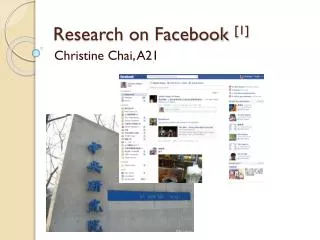
Research on Facebook [1] Christine Chai, A21
Who is Using YOUR FB Account? • Account name and password match… • True owner? Acquaintance? Stranger? • Facebook server decided to… • Record IP, Operation Systems, web browser • Suspect account misuse identify pictures • Research in Academia Sinica • Statistical method for browsing activities
Statistical Behavior • People generally do… • Account user = self • Click on “like” • Comment on a status • Account user = other • View personal messages • View private clubs
Experiment Design A B C D
Data Analysis • Data clean-up • Feature examples • Act: like, add_comment, follow_link • Expand: page, comments • View: photo, likes, message • Classification Other Self
Experimental Results • Accuracy: around 80% • Error: False positives and false negatives
Current Work [2,4] VPNconnect Download data Add/delete Features
Facebook: What’s in a Name? • Name Gender with > 90% accuracy • Popular name list (Lily Female; John Male) • Facebook profiles with gender specified • Local information: in a relationship / married • Data: Everything can be publicly accessed!
Conclusion • Be aware of what we do online. • Be responsible for what info we reveal.
References • Academia Sinicahttp://blog.libertytimes.com.tw/spieler/2008/07/04/16118 • Academia Sinicahttp://zh.wikipedia.org/wiki/%E4%B8%AD%E5%A4%AE%E7%A0%94%E7%A9%B6%E9%99%A2 • Introduction to Machine Learninghttp://www.cmpe.boun.edu.tr/~ethem/i2ml/ • National Taiwan Universityhttp://blog.chinatimes.com/may.lin/archive/2007/06/19/174928.html