The Power of a Teacher: Shaping Classroom Climate and Student Behavior
This insightful exploration underscores the pivotal role teachers play in the classroom environment. Hiam Ginott's profound reflections emphasize that teachers can influence students' emotional landscapes, making them either sources of inspiration or distress. The discussion expands to effective classroom management strategies, highlighting models like Assertive Discipline and the importance of clear expectations, positive reinforcement, and a well-structured physical environment. By understanding their influence and responsibilities, educators can foster a nurturing atmosphere that enhances learning and growth.

The Power of a Teacher: Shaping Classroom Climate and Student Behavior
E N D
Presentation Transcript
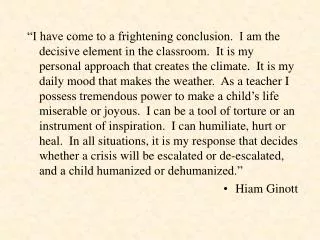
“I have come to a frightening conclusion. I am the decisive element in the classroom. It is my personal approach that creates the climate. It is my daily mood that makes the weather. As a teacher I possess tremendous power to make a child’s life miserable or joyous. I can be a tool of torture or an instrument of inspiration. I can humiliate, hurt or heal. In all situations, it is my response that decides whether a crisis will be escalated or de-escalated, and a child humanized or dehumanized.” • Hiam Ginott
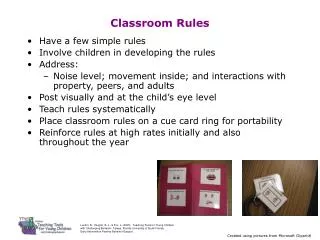
Classroom Structure • Classroom Management: • Physical layout of classroom • Manageable room • Accessible materials • Procedures clearly stated and understood by students • Behavior Management: • Rules should be clearly stated and consistently reinforced throughout the year.
Historical Perspective • Traditional • Bureaucratic and Monitorial • New England Pedagogy • Progressive • Conservative Restoration
Models for Classroom Structure: • Lee Canter • Assertive discipline • Teachers should insist on responsible behavior • Many teachers fail to discipline because they believe that firm discipline is inhumane
Assertive Discipline: Teachers • Teachers have three basic rights as educators: • To maintain an optimal classroom setting for learning • Expect appropriate behavior • Expect help form administrators as well as parents
Assertive Discipline (students): • Students have three basic rights: • To have teachers who help them develop and grow by limiting self-destructive behaviors • Teachers who support and encourage appropriate behavior • Students should have prior of the consequences of their behavior
Canter Model of Classroom Behavior: • The following items are essential to good behavior management • State and clearly teach expectations early • Use “I” messages • Calm voice, eye contact, non-verbal gestures • Repeat the rules when needed • Firm, positive insistence
Jones Model of Classroom Behavior Management: • Reduce the loss of instructional time • Statistics: • 50% of class time is lost because of misbehavior and being off task • 80% is lost due to talking • 19% is lost to daydreaming, out of seat and making noises • 1% is lost to more serious behavior
Focus of Jones Model: • Apply effective body language * Use of body for non-verbal communication - Eye contact - Facial expression - Posture - Signals and gestures - Physical proximity • Incentive systems • Individual help
Mackenzie Model for Classroom Structure: • Structure is the organizational foundation of the classroom. • Common Misconceptions: • Teaching rules is the parents job • Children should know what to expect • Explaining the rules should be enough • Students resent firm rules and the teacher who makes them • Male teachers are the best disciplinarians
Mackenzie’s Setting Limits Program: • Rules in theory • Rules in practice • All rules should be introduced to students the first day • Broad and inclusive rules • Limit rules to three to five
Harry K. Wong’s Classroom Structure: • Main characteristics of effective teachers • Classroom management skills • Teaching for lesson mastery • Positive expectations • Classroom management is organization of students, space, time and materials.
Classroom Management: • Security • Accessible materials • Manageable room • Highly focused students • Clear expectations • Little wasted time, confusion or disruption
Managing Your classroom: • Engaged time • Academic time • Achievement • Predictable environment • Rules-(General and Specific) • Consequences • Rewards