Understanding Complementary, Supplementary, and Adjacent Angles in Geometry
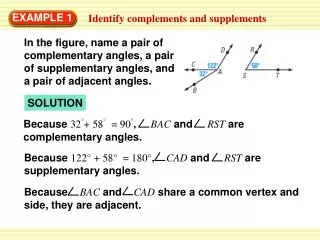
In this guide, we explore the concepts of complementary, supplementary, and adjacent angles using specific examples. Complementary angles are those that sum to 90°, while supplementary angles sum to 180°. We illustrate these concepts through angle pairs in a figure, specifically identifying angles such as BAC and RST as complementary, CAD and RST as supplementary, and demonstrate the adjacency of angles. Additionally, we provide guided practice questions to reinforce the understanding of these angle relationships, ensuring students can identify and explain these angles accurately.

Understanding Complementary, Supplementary, and Adjacent Angles in Geometry
E N D
Presentation Transcript
In the figure, name a pair of complementary angles, a pair of supplementary angles, and a pair of adjacent angles. Because 32°+ 58° = 90°, BACand RSTare complementary angles. Because 122° + 58° = 180°,CADand RSTare supplementary angles. Because BACand CADshare a common vertex and side, theyare adjacent. EXAMPLE 1 Identify complements and supplements SOLUTION
In the figure, name a pair of complementary angles, a pair of supplementary angles, and a pair of adjacent angles. 1. Because 41° + 49° = 90°, FGK and GKLare complementary angles. Because 49° + 131° = 180°,HGKand GKL are supplementary angles. Because FGKand HGKshare a common vertex and side, theyare adjacent. for Example 1 GUIDED PRACTICE
Are KGHand LKGadjacent angles ? Are FGKand FGHadjacent angles? Explain. 2. KGH and LKG do not share a common vertex , they are not adjacent. FGK and FGH have common interior points, they are not adjacent. for Example 1 GUIDED PRACTICE