Download
1 / 64
640 likes | 752 Vues
This article discusses the evolution of microlensing planet surveys and addresses the complexities and challenges encountered in this field. Led by Dan Maoz from Tel-Aviv University, the second generation of microlensing studies, which includes contributions from Yossi Shvartzvald and collaborations with OGLE, MOA, and microFUN, is examined. Key issues, such as survey strategies, detection efficiencies, and the rarity of observable planetary events, are outlined, along with the promising future of continuous monitoring and enhanced observational techniques.

E N D
Microlensing planet surveys: the second generation Dan Maoz Tel-Aviv University with Yossi Shvartzvald, OGLE, MOA, microFUN
Conceived problems with microlensing: • Seems complicated… • and hence results suspect… • No “follow up” of planets possible • 4. Statistically useless due to haphazard survey strategies • 5. Planet yield so small -- not worth trouble?
a R
I E S DLS DOL DOS a R
“microlensing” (in our Galaxy): In distant galaxies: “macrolensing”, “galaxy lensing”: cluster lensing:
I E S DLS DOL DOS a R
I+ S + b A - I- DLS DOL DOS a R I+S + SA = I+A
Magnification=image area / source area : magnification ~ 1/ (impact parameter)
Einstein-ring crossing timescale: t =E DOL / v ~ M1/2 S. Gaudi • ForDOL=8 kpc, • v=20 km/s • t(1Msun) = 2 months • t(1MJ)=2 days
The first microlensing lightcurves (LMC) Alcock et al. 1993
Nowadays, ~1000 microlensing events/yr detected toward Galactic bulge Yee+ 09
Gaudi et al. 2008 “Jupiter”+”Saturn” system: 1+2+3+5=“Saturn”, 4=“Jupiter”
Our solar system: 5.2 AU 9.5 AU 1 Msun 1 Mjup 1 Msat Msat/Mjup = 0.30 Rjup/Rsat = 0.55 Mc/Mb = 0.37 Rb / Rc = 0.50 OGLE-2006-BLG-109L,b,c: 2.3 AU 4.6 AU 0.50 Msun 0.71 Mjup 0.90 Msat
Second 2-planet system discovered: 0.7MJ (4.6 AU) and 0.1MJ (3.8 AU) Han+2012, OGLE-2012-BLG-0026
q = Mp / Mhost Simulation by S. Gaudi
Caustics: points in the source plane which get infinite magnification. For a point lens, caustic is a single point behind the lens. (source there gets magnified into Einstein ring)
Source passage on or near central caustics: high mag almost full Einstein ring ~100% detection efficiency for planets near Einstein radius (lensing region). planetary caustics: low mag Lower planet detection efficiency per event, but much more common. A. Cassan
Microlensing probes a unique region of planetary parameter space… Gould et al. 2006, 2009
…near the Einstein radii of stars ~ their snow lines. Gould et al. 2006, 2009 Snowline scaling with mass: star
Snowline-region planet frequency based on microlensing discovery statistics: Gould et al. (2010, based on 6 planets): ~1/3 of stars have snowline-region planets; ~1/6 of stars have solar-like planetary systems; Cassan et al. (2012, based on 2 (!) planets): ~1/6 host jupiters ~1/2 host neptunes ~2/3 host super-earths
To date, only ~20 microlensing planets. Why so few? “1st Generation” survey strategy (Gould & Loeb 1992) focused on bright, high-magnification (mag>100) events.
Udalski et al. 2005 Gould et al. 2006 Gaudi et al. 2008
1st Generation microlensing • low cadence (~ once a night) OGLE, Chile, 1.3m MOA, NZ, 1.8m
1st Generation microlensing ~ 650 events/year
1st Generation Microlensing Follow-up search for planetary perturbations with global network on bright, high-magnification events:
High-magnification (mag >100) events are: Good: ~100% sensitivity to planets projected near Einstein radius, + high S/N light curves even with small and amateur telescopes. Bad: Rare events (~1%) ~7 events/year 1-2 planets/year.
As opposed to high-mag (central caustic) events, Low-magnification (planetary caustic) events: Lower planet detection efficiency, but much more common: Potential for tens of microlensing planets/year. A. Cassan
Need network of 1-2m class telescopes with degree-scale imagers for continuous monitoring of many low-mag events in search of planetary perturbations: “Generation II microlensing”
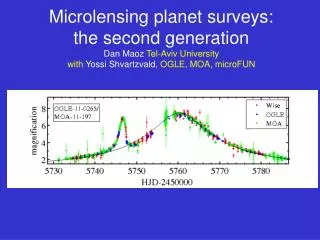
Since 2011: A generation-II microlensing experiment: Wise Obs., Israel, D=1m, 1 deg2 Yossi Shvartzvald is there OGLE IV, Chile, D=1.3m, 1.4 deg2 MOA-II, NZ, D=1.8m, 2.3 deg2