Download
1 / 1
10 likes | 164 Vues
This analysis examines the Environmental Impact Quotient (EIQ) ratings and mean environmental impact per hectare for UK vegetable crops from 1991 to 2003. It highlights the decline in pesticide toxicity over this period, in accordance with EU guidelines, while noting that reductions in toxicity do not always equate to a safer environment. The study suggests that the environmental impact per hectare remains a more accurate measure of pesticide use effects. Environmental implications of potentially exporting UK vegetable production to countries like Uganda are also discussed.

E N D
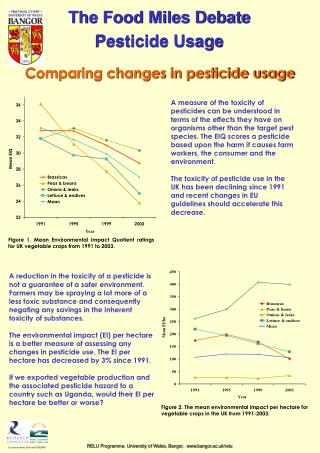
Figure 1. Mean Environmental Impact Quotient ratings for UK vegetable crops from 1991 to 2003. Figure 2. The mean environmental impact per hectare for vegetable crops in the UK from 1991-2003. The Food Miles Debate Pesticide Usage Comparing changes in pesticide usage A measure of the toxicity of pesticides can be understood in terms of the effects they have on organisms other than the target pest species. The EIQ scores a pesticide based upon the harm it causes farm workers, the consumer and the environment. The toxicity of pesticide use in the UK has been declining since 1991 and recent changes in EU guidelines should accelerate this decrease. A reduction in the toxicity of a pesticide is not a guarantee of a safer environment. Farmers may be spraying a lot more of a less toxic substance and consequently negating any savings in the inherent toxicity of substances. The environmental impact (EI) per hectare is a better measure of assessing any changes in pesticide use. The EI per hectare has decreased by 3% since 1991. If we exported vegetable production and the associated pesticide hazard to a country such as Uganda, would their EI per hectare be better or worse? RELU Programme, University of Wales, Bangor. www.bangor.ac.uk/relu Co-sponsored by Defra and SEERAD