Atoms and Elements
This comprehensive overview of atoms and elements delves into their fundamental structure, including protons, neutrons, and electrons. It explores the concept of elements as pure substances comprised of one type of atom, highlighting over 115 known elements with their symbols and atomic numbers. The document explains the distinctions between isotopes and emphasizes the calculation of atomic mass through weighted averages of naturally occurring isotopes. Additionally, it covers the arrangement of electrons in orbitals and the significance of periodic table organization, connecting atomic structure to chemical properties and reactivity.

Atoms and Elements
E N D
Presentation Transcript
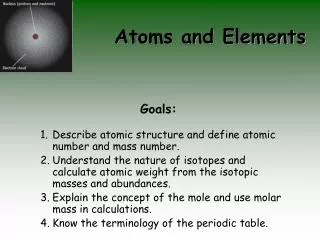
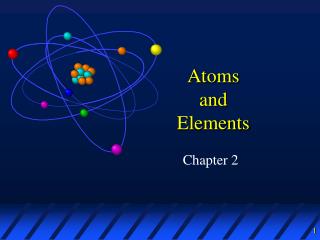
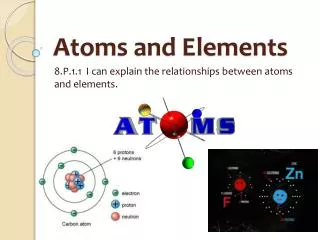
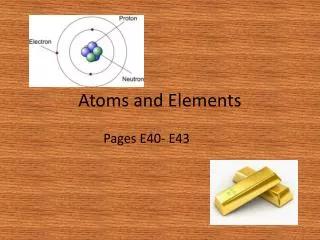
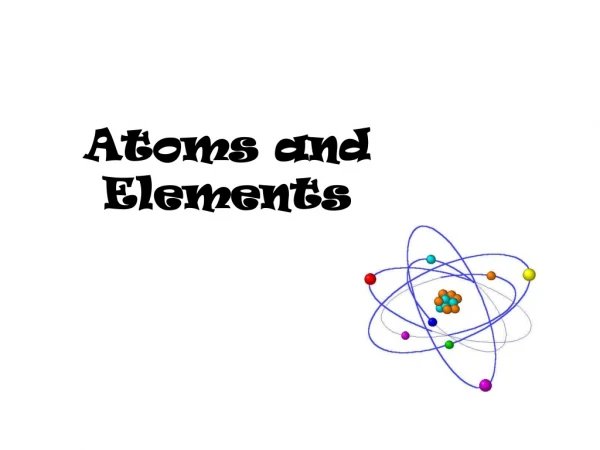
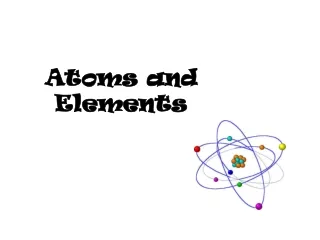
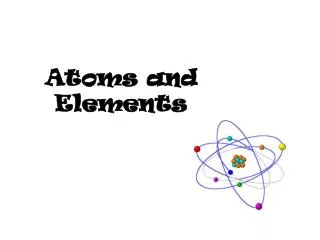
Structure of an Atom • Charges • Electron – negative • Proton – positive • Neutron - neutral • Parts • Nucleus – neutrons & protons • Orbitals - electrons
Elements • Pure chemical substances made up of one type of atom • Building blocks of matter • Over 115 elements known - and more being discovered
Elements – Symbol / Name Examples: Latin C Carbon Au Gold-aurum O Oxygen Lb Lead-plumbum Mg Magnesium K Potassium-kalium Br Bromine Na Sodium-natrium Symbol: one or two letter abbreviation
Elements – Atomic Number • ALL Carbon atoms have six protons, and …ALL atoms with six protons are Carbon • BUT… they can have different numbers of neutrons These are called isotopes of carbon DEFINES the element Atoms are neutral… so have same # electrons (-) as protons (+)
Elements – Atomic Mass • MASS NUMBER = mass of all particles in one atom (protons, neutrons and electrons) • Measured in “atomic mass units” (amu) Calculated from Mass Number
Elements – Mass Number • MASS NUMBER = mass of all particles in one atom (protons, neutrons and electrons) • Mass of 1 proton = 1 amuMass of 1 neutron = 1 amuMass of 1 electron = really, really tiny! • SO… mass number = # protons + # neutrons • Carbon • 6 protons x 1 amu/proton = 6 amu • 6 neutrons x 1 amu/neutron = 6 amu • 6 electrons x really tiny mass = 0 amu TOTAL = 6 amu + 6 amu + 0 amu = 12 amu
Elements – Mass Number Helium Nitrogen Atomic Number = Mass Number = 2 (protons)4 amu (p + n) Atomic Number = Mass Number = 7 (protons)14 amu (p + n)
Elements – Atomic Mass • BUT… Why is the atomic mass for Lithium (atomic number 3; with 3 protons) = 6.94?!?! • …. Isotopes NOTE: Mass number is used to name isotope Lithium-6 - 3 protons, 3 neutrons - mass number = 6 - 7.5% of all lithium Lithium-7 - 3 protons, 4 neutrons - mass number = 7 - 92.5 % of all lithium
Elements – Atomic Mass • BUT… Why is the atomic mass for Lithium (atomic number 3; with 3 protons) = 6.94?!?! • Calculation: Weighted Average (info. only): • 7.5 % Lithium-6 at 6 amu • 92.5 % Lithium-7 at 7 amu • (0.075 x 6 amu) + (0.925 x 7 amu) = (0.45 amu) + (6.48 amu) = 6.93 amu
Elements – Atomic Mass • The atomic mass of an element is calculated by doing a weighted average of the mass numbers of all naturally existing isotopes. • If you round the atomic mass of an element to the nearest whole number, you get the mass number of the most common isotope. 7.0
Elements – Symbol / Name Atomic Mass • “Average” for all carbon • Calculated from mass numbers of isotopes • On the periodic table Same # protons, different # neutrons Mass Number • Calculated for each individual isotope • Used to name the isotope • Averaged together to represent all carbon All have same # protons
Structure of an Atom • Outside the nucleus electron • Electron • Atomic mass 0 • Charge (-) nucleus (containing protons and neutrons)
Structure of an Atom • Electrons are arranged in orbits • Orbit 1 holds 2 electrons • Orbit 2 holds 8 electrons • Orbit 3 holds 8 electrons…
Structure of an Atom • Nucleus – the center of an atom contains… • Protons • Atomic mass 1 • Charge (+) • Neutrons • Atomic mass 1 • Charge none
Symbols • Either 1 or 2 letters symbols • First letter Capital, second lower case • Some based on Latin name Example Latin C Carbon Au Gold-aurum O Oxygen Lb Lead-plumbum Mg Magnesium K Potassium-kalium Br Bromine Na Sodium-natrium
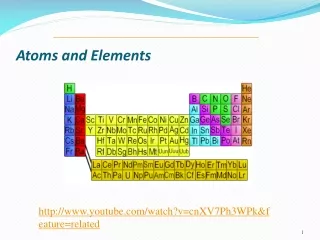
The Periodic Table • Elements are arranged by size and chemical properties. • Rows • Period • Size • Columns • Group • Properties
Properties • Properties are related to atomics structure. • The number of electrons in the outer most orbit (valence electrons) determine how an atom will behave in chemical reactions.