The Forecast Process
This resource explores the intricate processes involved in weather forecasting, emphasizing the significance of different scales of motion, including global, synoptic, and mesoscale. It outlines various forecasting methods such as climatology, persistence, trend extrapolation, analogue methods, teleconnections, decision trees, and numerical weather prediction. Through systematic approaches, meteorologists can evaluate current conditions and make informed predictions about future weather phenomena, integrating data analysis and understanding of atmospheric dynamics.

The Forecast Process
E N D
Presentation Transcript
The Forecast Process ATMO 4300 Spring 2010
Scales of Motion • Global (Planetary) Scale • Synoptic Scale • Mesoscale
Seasonal Position of Jet StreamFigure from www.earth.rochester.edu/fehnlab/ees215/fig17_8.jpg
Scales of Motion • Global (Planetary) Scale • Synoptic Scale • Mesoscale
Scales of Motion • Global (Planetary) Scale • Synoptic Scale • Mesoscale
Climatology • Using long-term averages to forecast a particular weather element • Example: • What’s the problem with using Climatology?
Persistence • Current Weather = Future Weather • Accuracy depends on: 1. Time scale 2. Progressive vs. stagnant weather pattern • Example:
Trend • Extrapolating current weather out in time based on steady-state conditions • Best for approx 0-6 hours (Nowcasting) • Example: • What’s the problem with this method?
Analogue • Also called “Pattern Recognition” • Today’s weather similar to a past event • Forecast based on what happened with the past event • Example: • What’s the problem with this method?
Analogue - Example • Go to the following web site: • http://tropical.atmos.colostate.edu • Click on Forecasts • Click first “new” link • Scroll down to No. 5
Variations on Analogue Method • Teleconnections – Relationship between weather in one part of the globe to events in another part • Used in long-range forecasting • Example: El Nino – connection between tropics and North America
El Nino • What is it? • An event associated with significant warming of sea surface temperatures in the eastern tropical Pacific Ocean.
Normal Sea Surface Temps • Ocean temperatures are normally warmer in the west and colder in the east. • Figures from www.cpc.ncep.noaa.gov
Misconceptions about El Nino • El Nino or La Nina does not directly cause any one particular weather event.
Variations on Analogue Method • Decision Trees / Checklists • Using common parameters associated with many past events • “Rules of thumb” • Example:
Example of Decision Trees • Class Home Page • Click link to All NWS Offices • Click Midland on the map • Click Office Information • Click Local Research • Click on 5th article
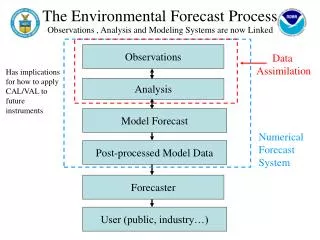
Numerical Weather Prediction • Using computer models of the atmosphere to predict weather variables • Model Output Statistics (MOS) • Ensembles
The Forecast Process • With all the data and the different forecasting methods, how do you decide what to forecast? • Rain or sunny • Snow amount • Graphic from www.lib.umassd.edu/graphics/judge.gif
A Systematic Approach • Start with the Big Picture - Look at the hemispheric (or partial hemispheric) upper wind flow pattern - Look at a large scale water vapor satellite animation (current & recent history)
A Systematic Approach • Review Synoptic Scale - Surface map – cyclones/anticyclones, air mass boundaries - Upper air maps – troughs/ridges, PVA/NVA, temp advection, meridional vs zonal flow - Radar/satellite – precip/clouds in and near forecast area
A Systematic Approach • Associate current weather with causes. Example: Evaluate moisture and lift for precip.
A Systematic Approach • What is the time period of your forecast? Example: 0 – 6 hours (Nowcast) Radar, satellite, profilers, detailed surface analysis Example: Days 1 to 7 Numerical Weather Prediction models
A Systematic Approach • Choose a forecast methodology(s) • What weather elements am I forecasting and what will affect those elements? • When forecasting different weather elements, usually best to forecast temps last.
Summary • What happened and why? • What is happening and why? • What is going to happen and why? • Adapted from Lance Bosart, SUNY, Albany