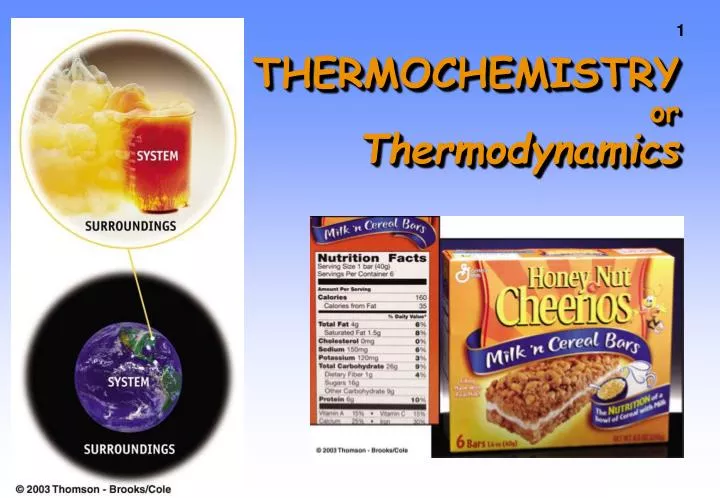
THERMOCHEMISTRY or Thermodynamics
260 likes | 391 Vues
This document explores the fundamental concepts of thermochemistry and thermodynamics, emphasizing energy transfer in chemical reactions. It explains the differences between heat, internal energy, potential and kinetic energy, and outlines the laws of energy conservation. Key definitions such as exothermic and endothermic processes are described, alongside the importance of thermal equilibrium and heat capacity. Examples with calculations illustrate specific heat capacity and the heat required for phase changes, providing a comprehensive overview for students and enthusiasts in chemistry.


THERMOCHEMISTRY or Thermodynamics
E N D
Presentation Transcript
Energy & Chemistry ENERGY is the capacity to do work or transfer heat. HEAT is the form of energy that flows between 2 objects because of their difference in temperature. Other forms of energy — • light • electrical • kinetic and potential
Energy & Chemistry All of thermodynamics depends on the law of CONSERVATION OF ENERGY. • The total energy is unchanged in a chemical reaction. • If PE of products is less than reactants, the difference must be released as KE.
Internal Energy (E) • PE + KE = Internal energy (E or U) Int. E of a chemical system depends on • number of particles • type of particles • temperature
Thermo-dynamics the science of heat transfer (molecular motions). Heat transfers until thermal equilibrium is established.
T(system) goes down T(surr) goes up (until it reaches equilibrium Directionality of Heat Transfer • Heat always transfer from hotter object to cooler one. Heat lost = heat gained • EXOthermic: heat transfers from SYSTEM to SURROUNDINGS.
T(system) goes up T (surr) goes down Directionality of Heat Transfer • Heat always transfer from hotter object to cooler one. Heat lost = heat gained • ENDOthermic: heat transfers from SURROUNDINGS to the SYSTEM.
ENERGY TRANSFER • IDENTIFY SURROUNDINGS AND SYSTEM. • EXOTHERMIC OR ENDOTHERMIC ?
Heat is NOT temperature The increased volume with temperature causes the mercury to rise
James Joule 1818-1889 UNITS OF ENERGY 1 calorie = heat required to raise temp. of 1.00 g of H2O by 1.0 oC. 1000 cal = 1 kcal = 1 Calorie (a food “calorie”) But we use the unit called the JOULE 1 cal = 4.184 joules
HEAT TRANSFER The quantity of heat transferred depends on: • The quantity of material 2. The size of the temperature change 3. The identity of the material gaining or losing heat
HEAT CAPACITY Specific heat = The heat required to raise 1 g of substance 1 ˚K.
Heat Calculations Specific heat capacity (J/ g * K) Change in temperature (K) q = C * m * ∆T Mass of substance (g) Heat transfer (J)
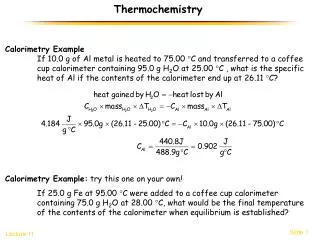
heat gain/lose = q = (sp. ht.)(mass)(∆T) Specific Heat Capacity If 25.0 g of Al cool from 310 oC to 37 oC, how many joules of heat energy are lost by the Al?
Specific Heat Capacity where ∆T = Tfinal - Tinitial q = (0.897 J / g•K)(25.0 g)(37 - 310)K q = - 6120 J Notice that the negative sign on q signals heat “lost by” or transferred OUT of Al.
Change of State: Heat of Fusion constant T q = (heat of fusion)(mass) Ice + 333 J/g (heat of fusion) -----> Liquid water
Heating/Cooling Curve for Water Evaporate water Heat water Note that T is constant as ice melts Melt ice
+333 J/g +2260 J/g Heat & Changes of State What quantity of heat is required to melt 500. g of ice and heat the water to steam at 100 oC? Heat of fusion of ice = 333 J/g Specific heat of water = 4.2 J/g•K Heat of vaporization = 2260 J/g
Heat & Changes of State 1. melt ice 0 oC q = (500. g)(333 J/g) = 1.67 x 10⁵ J 2. water from 0 oC to 100 oC q = (500. g)(4.2 J/g•K)(100 - 0)K = 2.1 x 10⁵ J 3. To boil water 100 oC q = (500. g)(2260 J/g) = 1.13 x 10⁶ J 4. Total q = 1.51 x 10⁶ J = 1510 kJ