Dynamics and Conservation Laws in Collision Experiments
Solve equations involving momentum and conservation laws in two collision experiments to determine speed, displacement, and angles of moving objects.

Dynamics and Conservation Laws in Collision Experiments
E N D
Presentation Transcript
Problem B-2 from 2001
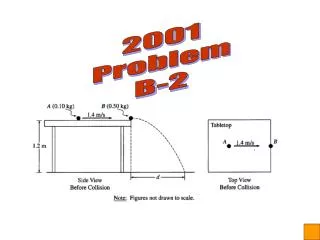
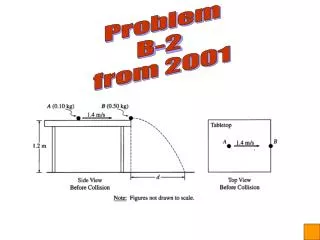
2. (15 points) An incident ball A of mass 0. 10 kg is sliding at 1.4 m/s on the horizontal tabletop of negligible friction shown above. It makes a head-on collision with a target ball B of mass 0.50 kg at rest at the edge of the table. As a result of the collision, the incident ball rebounds, sliding backwards at 0.70 m/s immediately after the collision.
1 point - Conservation of momentum 2 points - Substitution of values 1 points - Correct answer (a) Calculate the speed of the 0.50 kg target ball immediately after the collision.
2 points - Time of fall 2 points - Correct substitutions 1 points - Correct answer The tabletop is 1.20 m above a level, horizontal floor. The target ball is projected horizontally and initially strikes the floor at a horizontal displacement d from the point of collision. (b) Calculate the horizontal displacement d.
In another experiment on the same table, the target ball B is replaced by target ball C of mass 0.10 kg. The incident ball A again slides at 1.4 m/s, as shown above left, but this time makes a glancing collision with the target ball C that is at rest at the edge of the table. The target ball C strikes the floor at point P, which is at a horizontal displacement of 0.15 m from the point of the collision, and at a horizontal angle of 30o from the +x-axis, as shown above right.
1 point - Equation for speed 1 point - Substitution for time 1 points - Correct answer (c) Calculate the speed v of the target ball C immediately after the collision.
1 point - Conservation of momentum 1 point - Compute y-component 1 point - Correct answer (d) Calculate the y-component of incident ball A's momentum immediately after the collision.
Problem B-3