Download
1 / 23
230 likes | 351 Vues
This report analyzes the prevalence and dynamics of Tuberculosis (TB) and HIV co-infection in Indonesia from 2003 to 2005, focusing on patient demographics, treatment success rates, and health-seeking behaviors. It highlights findings from various health facilities, revealing a significant proportion of TB patients also living with HIV. The study aims to identify gaps in case detection and treatment success while addressing the challenges in TB service accessibility, especially in rural areas. Recommendations for improving DOTS implementation and enhancing community engagement in TB services are also discussed.

E N D
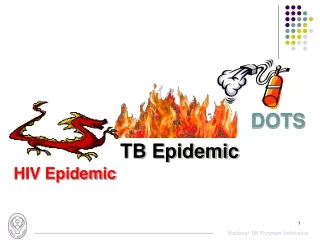
DOTS TB Epidemic HIV Epidemic
Average age male/female patients 2003 data (Lowest mean age in provinces with high HIV prevalence)
Urban TB clinic (PPTI) 2004: • TB patient 44 IDU VCT 22 (50%) HIV+ 11 (50%) SS- 1 Sep 2004 – 31 Aug 2005: • 641 TB patient VCT 147 (23%) HIV(+) 90% SS(-)
TrainedHealth Center Staffper Provincemid 2005 Medical Doctors Paramedics LEGEND : % Trained to Standard < 50% 50 – 80% 81 – 100% 100% Lab Technician
Hospital distribution (absolute numbers)
Summary of hospital distribution & involvement TOTAL 213,722,300 1259 297 24
Involving all health facilities and all provider increasing Case NotificationWarning!! Treatment Success
3 Persahabatan Hospital Retrospective Study July 1999 – June 2001 “DOTS” SAT Cured 47 (19.75%) 97 (7.28%) Complete 82 (34.45%) 470 (35.26%) Failed 4 (1.68%) 4 (0.3%) Drop out 88 (36.9%) 670 (50.26%) Move 17 (7.14%) 67 (5.03%) Died 0 0 Others 0 25 (1.88%) Total no of cases 238 1333
Lung hospital and clinics low success rate Percent of TB-patients who were cured or completed treatment, by province, 2002 Completed 100% Cured 90% 80% 70% 60% proportion of cohort 50% 40% 30% 20% 10% 0% Bali NTT NTB Riau Jambi Babel Aceh Papua Maluku E Java C Java Banten Jakarta BP4-RS W Java N Maluku Bengkulu Lampung Gorontalo N Sumatra S Sumatra W Sumatra N Sulawesi C Sulawesi S Sulawesi Yogyakarta E Kalimantan C Kalimantan S Kalimantan SE Sulawesi W Kalimantan
Proportion of Case Notifiedby Health Clinics & Lung Clinics/Hospital
Treatment-seeking practices of patients with history of TB (Prevalence survey 2004)
Towards 70% case-detection • Indonesians when sick go to Puskesmas (60%-urban and 70% rural) • TB services are available and 'gratis' BUT: • Perception population= “puskemas are for poor” • Treatment seeking to servicesregional differences • Weak ACS capacity at province/ district level We need to build capacity of DOTS teams to promote TB services Health-seeking behaviors:The percentage of people with TB symptoms who have the intention to seek treatment…
Knowledge about TB Source of TB informationUrban-Rural differences
Donor Support to Provinces – phased expansion Q1 - Q3 2003 (GF 8 provs) Q4 2004 (GF 16 provs) Q5 2004 (GF 19 provs) Q9 2005 (GF 21 provs) = GFATM = DUTCH GOVT. = KNCV + + USAID + GF-ATM (Q9) = CIDA + USAID+ GF-ATM (Q9) = TBCTA/ USAID
WHO-Recommended Global Strategy to Stop TBand Reach the 2015 MDGs • Pursuing quality DOTS expansion and enhancement • Political commitment • Case detection through bacteriology • Standardised treatment, with supervision and patient support • Effective drug supply system • Monitoring system and impact evaluation Additional components: 2 Addressing TB/HIV and MDR-TB 3. Contributing to health-system strengthening 4. Engaging all care providers 5. Empowering patients and communities 6. Enabling and promoting research Stop TB Department
Budgeting Indonesia’s TB-Control Program propose to the GF-Rnd5