Download
1 / 7
70 likes | 192 Vues
This text delves into the role of the Executive Office of the President (EOP) and how it differs from cabinet departments and independent agencies (IAs). The EOP is a small group of advisors located in the West Wing, closely working with the President. Key positions include the Chief of Staff, National Security Advisor, and Press Secretary. Unlike cabinet departments and IAs, which execute laws and are on the "front lines," the EOP is considered a "staff" agency, primarily providing advice and support to the President.

E N D
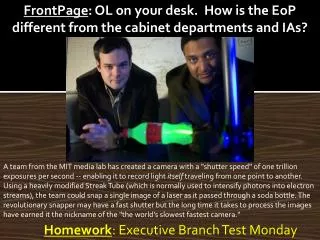
FrontPage: OL on your desk. How is the EoP different from the cabinet departments and IAs? A team from the MIT media lab has created a camera with a "shutter speed" of one trillion exposures per second -- enabling it to record light itself traveling from one point to another. Using a heavily modified Streak Tube (which is normally used to intensify photons into electron streams), the team could snap a single image of a laser as it passed through a soda bottle. The revolutionary snapper may have a fast shutter but the long time it takes to process the images have earned it the nickname of the "the world's slowest fastest camera." Homework: Executive Branch Test Monday
Chapter 8, Section 4 The Executive Office of the President
What is the “Executive Office of the President?” • Small group of advisors and offices, mostly located in the West Wing • Closest to the President; most may work with him nearly every day • Includes: • Chief of Staff • National Security Advisor • Senior Advisor • Personal Secretary • Chief White House Counsel (lawyer for Prez) • Personal Aide to the President • Press Secretary • Other aides
How is the EoP different from the rest of the Executive branch? • EOP • Considered “staff” agencies: • advise the president • Provide information, advice and support • Cabinet depts, IA’s • Considered “line” agencies (on the “front lines”) • carry out the laws • “do the work” of executing laws of US