Separation Methods
Explore various ways to separate mixtures based on physical properties like filtration, chromatography, centrifuging, and more. Learn about techniques such as crystallization and decantation for efficient separation.

Separation Methods
E N D
Presentation Transcript
Separation Methods Ways to separate mixtures – Chapter 3: Matter & Its Properties
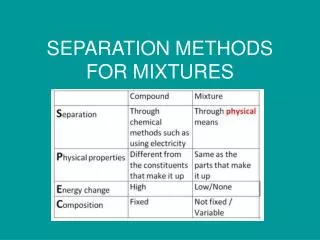
Separating Mixtures • Substances in a mixture are physically combined, so processes bases on differences in physical properties are used to separate component • Numerous techniques have been developed to separate mixtures to study components
Filtration • Chromatography • Centrifuging • Evaporating • Crystallization • Dissolving • Decantation • Sieving • Flotation • Physical Means
Filtration • Used to separate heterogeneous mixtures composed of solids and liquids • Uses a porous barrier to separate the solid from the liquid • Liquid passes through leaving the solid in the filter paper
Filtration can be used to separate an insoluble substance from a soluble substance
Distillation • Used to separate homogeneous mixtures • Based on differences in boiling points of substances involved
Evaporation can be used to separate a solute from the solvent in a solution
Crystallization • Separation technique that results in the formation of pure solid particles from a solution containing the dissolved substance • As one substance evaporates, the dissolved substance comes out of solution and collects as crystals • Produces highly pure solids • Rocky candy is an example of this
Centrifuges rotate containers of • liquids to separate suspended • materials with different densities. • Centrifuges separate different components of human blood or milk and to clarify solutions. A high speed separator can rotate at great speed to separate fat (cream) from milk. • The spin drier in washing machines is a type of centrifuge that throws out the liquid by the "centrifugal force" of the rotation.
A magnet • Can be used to separate a magnetic substance from a non-magnetic substance
Chromatography • Separates components of a mixture based on ability of each component to be drawn across the surface of another material • Mixture is usually liquid and is usually drawn across chromatography paper • Separation occurs because various components travel at different rates • Components with strongest attraction for paper travel the slowest
Chromatography ( colour writing) is used to separate small amounts of chemicals so that they can be analysed. • Different substances or different components move at different speeds through a strip of wet paper a gel or a gas.
Decantation • Decanting is done to separate particulates from a liquid by allowing the solids to settle to the bottom of the mixture and pouring off the particle-free part of the liquid. Another method is to allow two immiscible liquids to separate and the lighter liquid is poured off.
Sieving • a porous material is used to separate particles of different sizes. • method is most commonly used to effect gross separations, as of liquids from suspended crystals or other solids. • to accelerate filtration, pressure usually is applied. • a series of sieves is stacked, with the screen of largest hole size at the top