Falling is a common danger for those aged 65 and above, leading to severe injuries and fatalities. This comprehensive guide explores the various causes of falls among the elderly, including environmental hazards and health conditions affecting balance. It also outlines effective interventions like balance training and posture strategies to reduce fall risk. By addressing both physical and environmental factors, this resource aims to enhance elderly individuals' safety and quality of life.
Une image / un lien ci-dessous est fourni (tel quel) pour télécharger la présentation
Politique de téléchargement : le contenu du site vous est fourni TEL QUEL pour votre information et votre usage personnel ; il ne peut être vendu, concédé sous licence ni partagé sur d’autres sites sans l’accord de son auteur.Le contenu vous est fourni TEL QUEL, pour votre information et votre usage personnel uniquement.Téléchargez la présentation en cliquant sur ce lien.Lors du téléchargement, si vous ne parvenez pas à télécharger une présentation, l’éditeur a peut-être supprimé le fichier de son serveur.Pendant le téléchargement, si vous ne parvenez pas à obtenir une présentation, le fichier a peut-être été supprimé par l’éditeur.
F I N
Plus de contenu associé
Transcription de la présentation
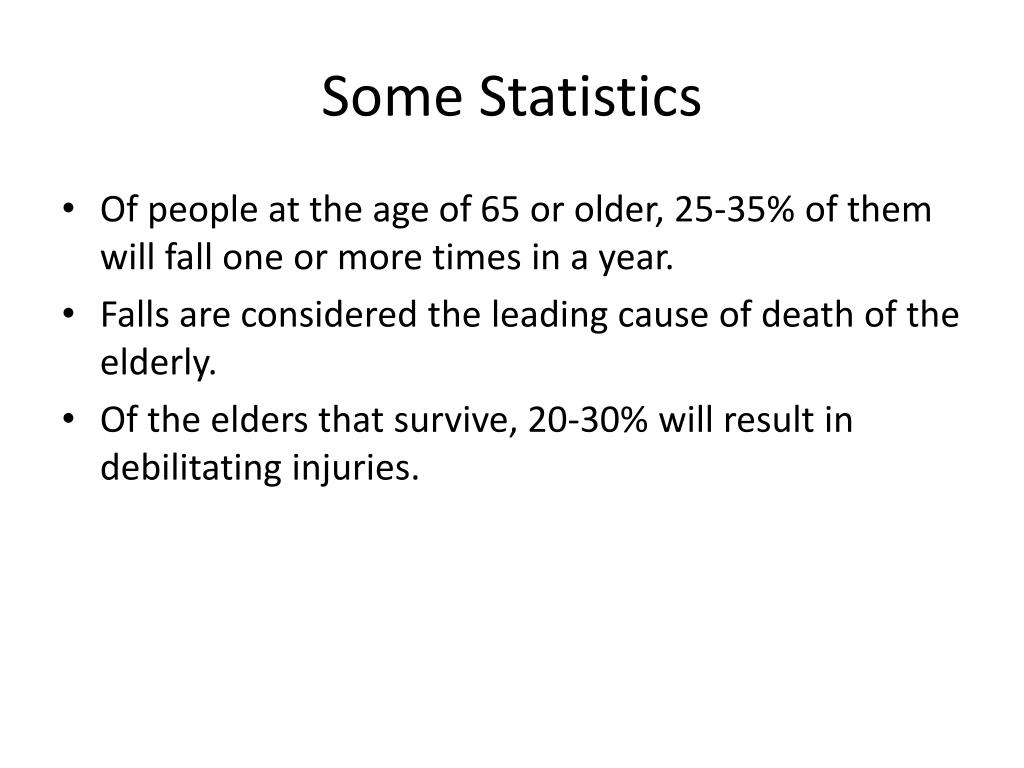
Some Statistics • Of people at the age of 65 or older, 25-35% of them will fall one or more times in a year. • Falls are considered the leading cause of death of the elderly. • Of the elders that survive, 20-30% will result in debilitating injuries.
Other Causes of Falls Include • Inappropriate footwear • Unstable bed or chair transfer • Gait disturbance • Balance impairment • Muscle weakness • Low Endurance
More Causes of Falls • Poor Posture • Visual Disorders • Disorders of the Central Nervous System (Alzheimer's, Parkinson’s, stroke, Cerebral Palsy) • Dementia (due to cognitive impairment and confusion)
Interventions for Fall Risk • Center of gravity control training • Standing balance training • Somatosensory balance training • Vestibular balance training • Eye-Head coordination • Postural strategies • Strength and endurance
Center of Gravity Control • Seated on backless chair • Dynadisk • Balance Ball • Arm lifts – single, double, diagonal • Lateral Rotation • Lean forward and backward • Add bouncing, resistance and perturbations to progress
Standing Balance • Standing Read out loud • On foam toss ball hand to hand • Stand one foot on ball • March with head turn • Stepping over objects • Four corner toe touch
Somatosensory • Seated on ball, dynadisk, backless chair • Weight shift, eyes closed (focus on pressure felt) • Toss and catch ball, follow object with eyes and head • Read while walking • Stand on tip toes reach for object • Standing place objects from one shelf to another.
Vestibular • Progressions: • Seated: backless chair, dynadisk, ball, • Standing: feet on floor, feet on foam, feet together, feet in tandem, single leg • Moving: Arms, legs, ambulation • eyes open, eyes closed
Eye-Head Coordination Progressions: Seated, Standing or Moving Follow object with eyes only, add head, add weight shifts. Direction of eyes and head: up, down, side to side, diagonal
4 Postural Strategies • Ankle and Hip Strategies • Stepping Strategies • Moving Strategies • Pool Strategies
Ankle and Hip Strategies • Chair in front and in back of pt. • (close for ankle farther apart for hip strategy) • Patient leans back and forth • Progress by adding foam, ½ foam roll or balance board
Stepping Strategy • Patient leans forward, backward and sideways until they need to take a step. • Place tape on the floor to encourage them to take bigger steps • Progress using foam, ½ foam roll, or balance board
Moving Strategy • Ambulate using: • Narrow steps • Wide steps • High March • Abrupt starts, stops and turns • Progress: hold object in hands, stepping on to foam or ½ foam roll
Pool Strategies • Pool are a great environment for balance exercises as the provide • naturally occurring perturbations • Patient safety, will not fall to floor • Reduces the fear factor associated with falls • Buoyancy of water provides support to patients suffering with pain.
Strength and Endurance Balance, Strength and Endurance can be worked on at the same time • Use a theraball, ankle weights, hand weights or theraband. • Incorporate normal exercises while on the ball • Pools offer the same advantage